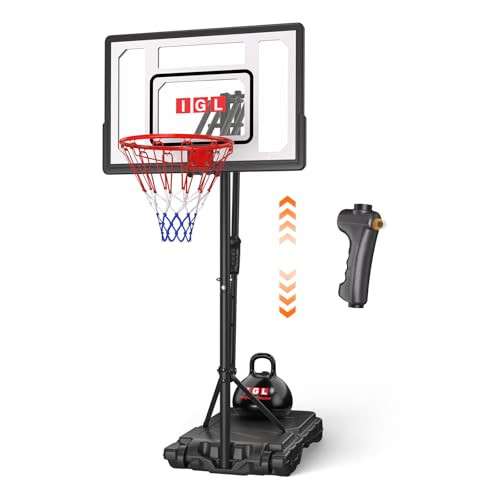
The best basketball hoop can turn a driveway, patio, or backyard into a convenient practice space for shooting, games, and family fun. The right choice depends on available space, player age, height range, portability, and how much stability you need.
We’ve gathered 10 basketball hoops for backyards, including portable, indoor-outdoor, kids’ adjustable, and in-ground designs. Use the guide below to narrow the options by setup, durability, and playing style before you buy.
Best 10 Basketball Hoops for Backyards Picks for 2026
For families comparing basketball hoops for backyards, this portable model is a practical pick for younger players who need an adjustable goal that can grow with them. Its 33-inch polycarbonate backboard, wheels, and indoor/outdoor design suit casual practice in a driveway, garage, or backyard.
Best For: Kids, teens, and youth players who need a movable hoop with a lower height range.
Pros:
Adjusts from 5.5 to 7.5 feet for growing players.
Shatter-resistant polycarbonate backboard and reinforced steel frame.
Base supports up to 110 pounds of combined sand and includes two wheels.
Designed for indoor or outdoor use with labeled parts and instructions.
Cons:
Its 33-inch backboard is smaller than the boards on the other featured systems.
The maximum height is 7.5 feet, so it is less suited to full-height training.
This hoop emphasizes family-friendly adjustability and portability rather than competitive-size play. It is a sensible backyard starting point for younger players and casual household use.
This Garvee system stands out among basketball hoops for backyards because its modular pole setup covers both low recreational play and near-regulation-height training. The 48-inch polycarbonate backboard, triangular base, and mobility wheels make it suitable for driveways, backyards, and occasional indoor use.
Best For: Adults and mixed-skill players who want a broad height range and a larger backboard.
Pros:
Offers two configurations from 4.9–6.9 feet or 8–10 feet.
Features a 48-inch shatterproof polycarbonate backboard and dual shock-absorbing rims.
Triangular base supports up to 150 pounds of water or 225 pounds of sand.
Integrated casters and a snap-fit assembly design support easier repositioning and setup.
Cons:
At 79.4 pounds, it is heavier than the kid-focused options.
The listed manufacturer warranty is 30 days.
With its larger backboard and 10-foot maximum height, this is the most versatile choice for households that want casual play now and more demanding practice later. The substantial base also favors users who prioritize stability.
Families seeking basketball hoops for backyards may prefer this lightweight Play22 model for straightforward kids’ play. It adjusts from 5 to 7 feet, includes move-around wheels and a fillable base, and is designed for indoor and outdoor use in spaces such as garages, playrooms, and yards.
Best For: Kids, youth players, and families wanting a compact, simple-to-assemble hoop.
Pros:
Adjusts from 5 to 7 feet for younger players.
Weighs 20 pounds and includes wheels for portability.
Uses weather-resistant materials, a steel main pole, and an all-weather nylon net.
Illustrated instructions and included tools simplify assembly.
Cons:
Its 5–7-foot range is limited for older or advanced players.
The supplied details list plastic and nylon frame materials rather than a steel frame construction.
The item details identify indoor usage, despite the product description also presenting it for outdoor play.
This is a practical entry-level option when easy movement and a lower playing height matter more than a large backboard or full-height training. Its 20-pound weight makes repositioning especially manageable.
For serious home practice, this Garvee system is one of the more training-oriented basketball hoops for backyards. Its hand-pull adjustment spans 5.6 to 10 feet, while the impact-resistant polycarbonate backboard, weighted base, and rolling wheels support repeated shooting drills in a driveway or backyard.
Best For: Teenagers and players who want adjustable practice from close-range shots through full-height play.
Pros:
Adjusts from 5.6 to 10 feet for varied drills and game-style practice.
Impact-resistant polycarbonate backboard is designed for repeated use.
Base accepts up to 44 kg of water or 63 kg of sand, with an extra sandbag attachment area.
Its outdoor-focused design may be less convenient for routine indoor use.
This model balances a child-friendly minimum height with a 10-foot maximum, making it a strong choice for households that expect player skill levels to change. Its heavier construction and weighted base are better suited to regular practice than occasional play.
If you want basketball hoops for backyards that can also work in a driveway or garage, this portable model offers a flexible setup. Its 44-inch shatterproof polycarbonate backboard, breakaway rim, and 7.5- to 10-foot height range support practice and casual competitive play for multiple age groups.
Best For: Teens, adults, and families who want an adjustable hoop for indoor or outdoor practice.
Pros:
Adjusts from 7.5 to 10 feet for different skill levels.
44-inch shatterproof backboard and breakaway rim support active practice.
Fillable base can use sand or water and allows portable placement.
Includes a two-year warranty for metal parts and one year for plastic parts.
Cons:
Base filling is required for added stability.
Its 44-inch backboard is smaller than the backboard on the in-ground option.
This is a versatile choice when portability matters but you still want a full adult-height setting and a responsive rim. The freestanding design makes it easier to reposition than a permanently installed system.
For families comparing basketball hoops for backyards, this kids-focused portable model emphasizes approachable height adjustment and easy movement. It adjusts from 70 to 84 inches, includes a 33-inch backboard, and has a fillable base with wheels for backyard, driveway, or indoor play.
Best For: Kids, youth players, and beginners who need a lower adjustable hoop.
Pros:
70- to 84-inch height range suits younger players and developing skills.
33-inch backboard provides a clear target for practice.
Wheels make it easier to move between play areas.
Weather-resistant and rust-resistant construction is intended for outdoor use.
Cons:
84-inch maximum height is below the 10-foot regulation-style setting.
The smaller backboard is less suited to adult competitive play.
This hoop is a practical starting point for children because its lower range makes shooting practice more accessible. Choose it when portability and youth-friendly sizing matter more than a full-size playing setup.
If stability and a larger target are priorities, this in-ground system is a strong contender among basketball hoops for backyards. It combines a 55-inch shatterproof backboard with a 7.5- to 10-foot adjustment range and weather-resistant steel for year-round outdoor use.
Best For: Families, teens, and adults seeking a more substantial backyard or driveway setup.
Pros:
55-inch shatterproof backboard offers a larger playing surface.
Height adjusts from 7.5 to 10 feet for different players.
Anti-tip safety design and solid steel rim support family use.
UV-protected, rust-resistant materials are designed for outdoor conditions.
Cons:
At 140.7 pounds, it is substantially heavier than a typical portable hoop.
Installation and placement are less convenient than a fully portable design.
The listed manufacturer warranty is limited to 30 days.
The larger backboard and sturdier construction make this the better fit for regular family play and more court-like practice. Consider it when durability and stability outweigh easy relocation.
For families comparing basketball hoops for backyards, this portable model stands out for its broad 4- to 8.5-foot adjustment range and dual-ballast setup. Its 33-inch polycarbonate backboard, wheels, and included anchor make it suitable for developing players who may use it in a driveway, garage, or backyard.
Best For: Families wanting one adjustable hoop for kids, teens, and youth players.
Pros:
Adjusts from 4 to 8.5 feet with a quick-adjust handle.
Dual ballast combines a fillable main base with an extra anchor.
Shatter-resistant 33-inch PC backboard and all-weather net.
Built-in wheels support relocation between play areas.
Cons:
The base and anchor require separate filling for maximum stability.
At 32 pounds before ballast, it still needs adequate filled weight for vigorous play.
This is a versatile choice when height flexibility and added base security matter most. The straightforward setup guidance and one-year manufacturer warranty add practical reassurance for family use.
This portable goal is a practical option among basketball hoops for backyards, offering ten height settings from 4 to 8.5 feet. Its tool-free quick-lift design, front wheels, and weighted HDPE base make it easy to adapt as children grow and move between outdoor or indoor play spaces.
Best For: Kids and teens who need frequent height changes without tools.
Pros:
Ten settings cover heights from 4 to 8.5 feet.
Quick-lift handle allows tool-free adjustment.
Base holds 9.5 gallons of water or 101 pounds of sand.
Weather-resistant construction and a 33-inch PC backboard support year-round use.
Cons:
The listed maximum height is 8.5 feet, below a standard full-height hoop.
Assembly configuration varies depending on whether two or three poles are used.
Choose this model if simple height changes are a priority. The substantial fillable base and golden-triangle design are aimed at keeping the system planted during active play, while the wheels make storage and repositioning more manageable.
For shoppers seeking basketball hoops for backyards that can serve different ages, this OLAKIDS system adjusts from 3.3 to 7 feet. Its compact height range, fillable base, storage slot, and two wheels make it suited to casual games around a backyard, driveway, poolside, or indoor space.
Best For: Families wanting a compact hoop for children, teens, and casual adult play.
Pros:
Adjusts from 3.3 to 7 feet in three steps.
Fillable base accepts up to 66 pounds of sand or 58 pounds of water.
Shatterproof PC backboard and detachable, wear-resistant net.
Includes wheels and a basketball storage slot.
Cons:
The 7-foot maximum is lower than the 8.5-foot maximum offered by the other listed models.
Its 15-inch rim is smaller than the 18-inch rims on the other two products.
The manufacturer warranty is six months.
This model makes sense when a lower, compact setup is more useful than a near-regulation height. Its three-step adjustment and family-oriented portability suit casual practice and shared recreation, while the tested safety-material claims provide additional context for buyers.
How We Picked These Basketball Hoops for Backyards
We focused on the features that matter most in a home basketball setup: adjustable height, backboard size and material, base stability, portability, rim construction, and suitability for different ages. The selection includes compact goals for young children, portable systems that can grow with players, and a more permanent in-ground option.
Because backyard conditions vary, we also considered practical details such as wheels, fillable bases, anchoring, storage, and whether each design works indoors as well as outdoors. Always confirm the listed dimensions and recommended use before ordering.
Quick Comparison
Type
Best For
Main Advantage
Trade-Off
Kids’ adjustable hoop
Young beginners
Lower height and simple play
Limited room to grow
Portable adjustable system
Families and older children
Height flexibility and mobility
Needs a weighted base
Indoor-outdoor hoop
Flexible home use
Can move between locations
May have a smaller backboard
In-ground hoop
Frequent, serious play
Greater permanence and stability
More difficult installation
Key Buying Factors for Basketball Hoops for Backyards
Height Adjustment
For younger children, a hoop that starts around 3 to 5 feet can make shooting more enjoyable. Older kids and teens may benefit from a system that reaches 8 to 10 feet. A wide adjustment range is useful when several players will share the hoop.
Backboard and Rim
Larger backboards provide more rebound area, while shatterproof plastic is typically a practical choice for casual outdoor play. A solid steel rim is preferable for repeated use. Check whether the rim is fixed or spring-loaded if players plan to practice more aggressively.
Base Stability and Installation
Portable models usually use a fillable base, often weighted with water or sand. A broader, heavier base generally improves stability, but it also makes moving the hoop harder. In-ground systems offer a more secure playing experience but require careful digging, anchoring, and assembly.
Space, Weather, and Storage
Measure the playing area, driveway clearance, and storage path before buying. Leave room behind and around the backboard for safe movement. Outdoor hoops should be protected from severe weather when possible, and portable models should be secured or lowered during strong wind.
Who Should Buy Which Basketball Hoops for Backyards?
For young beginners: Choose a low-adjustment kids’ hoop with a manageable base and smaller backboard. These are easier to use and less intimidating for first-time players.
For growing families: A portable system reaching approximately 10 feet offers the best balance of flexibility, value, and future use. Look for wheels, a stable fillable base, and a backboard large enough for regular practice.
For limited indoor and outdoor spaces: Select a compact indoor-outdoor design that can be repositioned without extensive setup. Confirm the height and base dimensions fit both locations.
For dedicated players: An in-ground hoop is the better long-term choice when the location is permanent and installation is practical. It typically provides a steadier feel than a portable model, but requires more planning and maintenance.