A wall-mounted gym can free up floor space without limiting you to one style of workout. The right choice depends on whether you want cable exercises, barbell training, or both.
These 10 options span adjustable cable stations, folding squat racks, and hybrid systems. Before choosing, check how each mounts, how far it projects from the wall, and what equipment you’ll need to add.
Best 10 Compact Wall Mounted Home Gym Picks for 2026
Best Selectorized Cable Tower
WM2-V4 Wall Mount Cable Station

- 155-pound selectorized stack
- 33 pulley-height positions
- 2:1 or 1:1 cable ratio
Best For: Quick cable-weight changes in a small space
Best Folding All-in-One

- Folds to 4.3 square feet
- Dual independent 1:1 pulleys
- Five training configurations
Best For: Combining rack and cable workouts with folding storage
Best Plate-Loaded Cable Station
19-Position Wall Mount Cable Machine

- Accepts 1- and 2-inch plates
- 19 pulley-height positions
- Includes five cable attachments
Best For: Plate owners seeking versatile cable exercises
Best Folding Barbell Rack
Mikolo Wall Mounted Squat Rack

- Folds to 2 inches deep
- Stated 1,000-pound capacity
- Pull-up bar and safety catches
Best For: Space-conscious barbell training
Best Compact Cable Station
GOIMU WM1 Wall Mount Cable Station
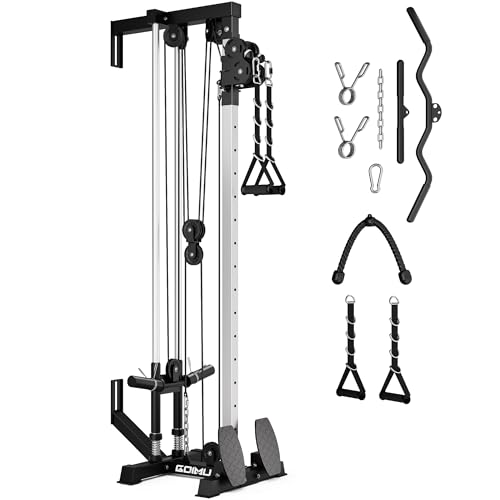
- Dual pulleys with 17 height positions
- Switchable 1:1 and 2:1 cable ratios
- Mounts to concrete or masonry
Best For: Cable-focused workouts in a small home gym
Best Folding Rack Combo
Wall-Mounted Power Rack with Dual Pulleys

- Rack and independent 1:1 cable pulleys
- Folds between workouts
- Includes pull-up bar and landmine
Best For: Barbell and cable training in a garage or basement
Best Adjustable Cable Arms

- 26 height holes and 13 arm angles
- Switchable 1:1 and 2:1 ratios
- Foldable arms; wood or concrete mounting
Best For: Full-body cable training with adjustable movement angles
Best Fold-Flat Rack

- Folds to a stated 2-inch depth
- Includes J-hooks, pull-up bar, and landmine
- Stated 1,100-pound weight capacity
Best For: Barbell training with minimal stored depth
Best Dedicated Cable Station
Mikolo Wall Mount Cable Station

- Built-in 118-pound weight stack
- 19 listed pulley height positions
- Includes adapter for combined 1:1 pulls
Best For: Cable-focused workouts without loading plates
Best Rack-and-Cable Combo

- Rack plus independent 1:1 cable pulleys
- 180-pound stack, split 90 pounds per side
- Includes safety arms and multi-grip pull-up bar
Best For: Combined barbell and cable training in one setup
Best Selectorized Cable Tower – WM2-V4 Wall Mount Cable Station
For a compact wall mounted home gym focused on cable training, the WM2-V4 combines a 155-pound selectorized stack with a plate-loading pin for 1- and 2-inch plates. Its stated footprint is about 24 by 33 inches, so it offers plenty of exercise angles without taking over the room.
Best For: Lifters who want quick weight changes and flexible cable resistance in a small space.
Pros:
- Selectorized stack makes changing resistance between sets straightforward.
- Included adapter lets you switch between 2:1 and 1:1 cable ratios.
- Offers 33 pulley-height positions and aluminum pulleys.
Cons:
- Needs wall mounting and roughly 79 inches of vertical clearance.
- Exercises beyond the 155-pound stack require weight plates.
This is the most convenient choice here for frequent cable-weight changes. Check your mounting location and ceiling height before ordering.
Best Folding All-in-One – WM3-V4 Folding Squat Rack
If your compact wall mounted home gym needs both a lifting rack and cable stations, the WM3-V4 brings those functions together in a folding design. It occupies a stated 4.3 square feet when stored and 12.3 square feet when deployed.
Best For: People who want rack workouts and dual-cable exercises but need to reclaim floor space afterward.
Pros:
- Five configurations include half-rack, functional-trainer, and cable-crossover modes.
- Dual independent 1:1 pulleys offer 15 adjustable heights.
- Includes a detachable pull-up bar, J-hooks, and safety arms.
Cons:
- Its deployed footprint is larger than its folded footprint.
- The supplied details do not list a weight stack; confirm your preferred resistance setup before buying.
Choose this model when folding storage matters as much as exercise variety. Allow room to open the rack fully for your workouts.
Best Plate-Loaded Cable Station – 19-Position Wall Mount Cable Machine
This plate-loaded option suits a compact wall mounted home gym if you already own weight plates. It pairs dual cables and 19 adjustable height positions with a stated footprint of 6.16 square feet.
Best For: Plate owners who want a wall-mounted cable station with several included handles.
Pros:
- Weight bar accepts both 1-inch and 2-inch plates.
- Includes two single handles, a triceps rope, a T-bar, and a lat pulldown bar.
- Rated for a maximum load of 400 pounds; the footplate lowers when not in use.
Cons:
- Weight plates are needed to add resistance.
- At 82.7 inches tall, it requires adequate wall and ceiling clearance.
Its attachment selection makes it a practical cable-training hub. Measure the installation space and account for the plates you plan to use.
Best Folding Barbell Rack – Mikolo Wall Mounted Squat Rack
For a compact wall mounted home gym built around barbell lifts, the Mikolo folding rack offers a stated 1,000-pound capacity and folds to about 2 inches deep. Unlike the cable-focused options above, its supplied features center on rack and pull-up training.
Best For: Barbell lifters who need a rack that folds close to the wall between sessions.
Pros:
- Folds from a stated 19.7-inch open depth to a 2-inch stored depth.
- Built with 2-by-2-inch, 13-gauge steel uprights.
- Includes a pull-up bar, J-cups, safety catches, and a T-bar row attachment.
Cons:
- No cable system is listed among its supplied features.
- Requires suitable wall space and an open width of 47 inches.
Pick this rack if barbell training is the priority and floor space needs to stay clear afterward. Choose a cable station instead if pulldowns and adjustable cable angles are essential.
Best Compact Cable Station – GOIMU WM1 Wall Mount Cable Station
The GOIMU WM1 is a compact wall mounted home gym for buyers who want cable-training variety without a full-size rack. Its dual independent pulleys offer 17 height positions, while the included adapter switches between 1:1 and 2:1 cable ratios.
Best For: Small home gyms focused on cable exercises such as rows, pulldowns, flyes, and pushdowns.
Pros:
- Includes a lat bar, cable bar, rope, and handles for varied exercises.
- Dual pulleys and selectable cable ratios add training flexibility.
- Wall-mounted design keeps the station close to the wall.
Cons:
- Installation requires a suitable concrete or masonry wall.
- Does not replace a squat rack for barbell training.
Choose the WM1 if cable work is your priority and you have the specified wall surface for mounting. Check the listed dimensions against your available training space before ordering.
Best Folding Rack Combo – Wall-Mounted Power Rack with Dual Pulleys
This folding rack takes a different approach to a compact wall mounted home gym: it combines a power rack with independent dual cable pulleys. Seven adjustable angles let you change its position, and the unit folds to reclaim space after a workout.
Best For: Garage or basement gyms that need both rack-based strength training and cable exercises.
Pros:
- Combines a rack, 1:1 dual cable system, pull-up bar, and landmine.
- Folding design helps free up room between workouts.
- Includes J-hooks and four adjustable ground support feet.
Cons:
- Requires secure wall mounting and floor contact for its support feet.
- The listed package weight is 151 pounds, so delivery and setup may take planning.
It is the more versatile pick if barbell work matters as much as cable training. Confirm your wall can accommodate the reinforced mounts and that you have adequate clearance when the rack is open.
Best Adjustable Cable Arms – GMWD G7 Pro Cable Machine
The GMWD G7 Pro suits shoppers seeking a compact wall mounted home gym with more freedom to position cable movements. Its dual swivel arms offer 26 height adjustment holes and 13 arm-angle settings, and the arms fold toward the wall when not in use.
Best For: Lifters who want adjustable cable angles for full-body exercises without a permanent freestanding trainer.
Pros:
- Adjustable swivel arms support a wide range of exercise positions.
- Dual cable bracket allows 1:1 or 2:1 resistance ratios.
- Includes a lat bar, cable bar, rope, handles, and mounting hardware for wood or concrete.
Cons:
- Needs suitable wall construction and secure installation.
- At 165 pounds, the unit may be cumbersome to handle during setup.
This is a strong fit when cable-angle flexibility is the deciding factor. Measure for its listed 39-inch depth when set up, even though it can fold back after training.
Best Fold-Flat Rack – MU Folding Squat Rack
If your compact wall mounted home gym needs room for barbell training, the MU folding squat rack offers J-hooks, an adjustable pull-up bar, and a detachable landmine. It extends 21.8 inches from the wall when open and folds to a stated 2-inch depth when not in use.
Best For: Lifters who want a wall-mounted rack for squats, presses, and pull-ups but need to reclaim floor space afterward.
Pros:
- Folds from a stated 21.8-inch depth to 2 inches.
- Includes J-hooks, a pull-up bar, and a detachable landmine.
- 2-by-2-inch steel frame has a stated 1,100-pound weight capacity.
Cons:
- No cable system is listed among the included components.
- At 85.8 inches tall, it requires adequate wall height.
This is the straightforward pick for barbell-focused training in a tight space. Its 1-inch accessory holes leave room to expand the setup, but add-ons such as spotter arms are not listed as included.
Best Dedicated Cable Station – Mikolo Wall Mount Cable Station
For a compact wall mounted home gym centered on cable exercises, the Mikolo station combines dual pulleys with a built-in 118-pound selectorized weight stack. Its 19 listed height positions let you move between high, middle, and low cable work without loading plates.
Best For: People who prioritize pulldowns, rows, flyes, and other cable exercises over barbell rack training.
Pros:
- Built-in weight stack adjusts by selector pin, with no separate plates needed.
- Dual pulleys offer 19 listed height positions.
- Includes a lat bar, triceps rope, handles, and an adapter for a 1:1 pull ratio when the cables are combined.
Cons:
- It is a cable station, not a squat rack.
- The full 118-pound selection at a 1:1 ratio requires connecting both cables with the included adapter.
Choose this if quick resistance changes and varied cable angles matter most. Its wall-mounted format helps preserve floor space, while the included attachments cover several common cable movements.
Best Rack-and-Cable Combo – JEEKEE Folding Power Rack
If you want a compact wall mounted home gym that handles both rack lifts and cable work, the JEEKEE folding power rack brings those functions together. It pairs a stated 2,400-pound-capacity rack with independent 1:1 cable pulleys and a 180-pound built-in stack split into 90 pounds per side.
Best For: Lifters who want barbell stations, cable crossovers, and pull-ups in one foldable wall-mounted setup.
Pros:
- Combines a power rack, dual cable system, multi-grip pull-up bar, and landmine.
- Built-in weight stack adjusts in stated 10-pound increments.
- Includes J-cups, safety arms, cable handles and bars, and plate storage holders.
Cons:
- Its listed 240-pound item weight calls for careful installation planning.
- The 180-pound stack is divided into 90 pounds per side.
This is the most equipment-rich option of the three, especially if switching between barbell and cable movements is a priority. Check your wall and available training clearance against the listed 56.3-by-53-by-84.7-inch product dimensions before committing.
How We Picked the Best Compact Wall Mounted Home Gym
We focused on the practical differences that matter in a small home gym: training versatility, usable floor space, mounting demands, resistance options, and included attachments. The selection includes cable-only stations, folding racks, and rack-and-cable combinations so you can compare layouts rather than just advertised weight capacities. Product specifications are a starting point, not a substitute for checking the current manual and the structure of your wall.
Quick Comparison: Which Layout Fits?
Cable station: A good fit for rows, pulldowns, presses, and accessory work when you do not need a barbell rack. Check whether resistance comes from a built-in weight stack or your own plates.
Folding squat rack: Better for barbell-focused training when you want to reclaim floor space between sessions. A rack may still need a separate bench, barbell, plates, and safety equipment.
Rack-and-cable hybrid: Offers both training styles on one wall, but usually demands more installation planning and working room. Confirm that the cable paths and rack positions suit the exercises you actually do.
Key Buying Factors for a Compact Wall Mounted Home Gym
Wall Structure and Installation
Mounting is the first filter. Verify the required stud spacing, hardware, wall construction, and any floor-anchoring requirements in the manufacturer’s instructions. Do not assume drywall anchors alone can support exercise loads. If the wall is unsuitable, choose another location or consult a qualified installer.
Open and Stored Footprint
Measure ceiling height, wall width, and the distance the unit extends into the room both open and stored. Leave room for a bench, barbell sleeves, cable handles, and your full range of motion. A folding rack saves space when closed, not necessarily while you are lifting.
Resistance and Exercise Range
Compare the actual training resistance, not just the stack size or headline rack rating. Pulley ratios can change the force you feel at the handle. For cable stations, check adjustment positions, arm movement, and whether high and low pulls are practical. For racks, check bar height, pull-up clearance, and compatibility with the safety accessories you want.
Total Setup Cost
Confirm what is included: handles, footplates, J-hooks, safeties, weight plates, or a built-in stack. Those differences can change the real cost and convenience of an otherwise similar-looking unit.
Who Should Buy Which Compact Wall Mounted Home Gym?
Choose a cable station if you prioritize controlled resistance and varied upper-body or accessory exercises over barbell squats. Choose a folding rack if heavy barbell lifts are your main goal and open floor space matters between workouts. A hybrid makes sense if multiple people train differently and you have a suitable wall, enough exercise clearance, and the budget for a more involved setup. When in doubt, choose the layout you will use most often rather than the one with the longest feature list.
Related Posts:

