Choosing among pull-up bars for seniors requires more than comparing weight limits. The right support should match the user’s transfer needs, available space, strength, and the furniture or bed it will be used with.
This roundup includes bed ladders, free-standing trapeze systems, chair-assist devices, and grab bars for different mobility situations. Use the guide below to compare stability, installation, adjustability, and everyday ease of use before buying.
For shoppers comparing pull up bars for seniors, the Stander BedCaddie is a compact bed-ladder aid designed to help users move from lying down to a seated position. Its graduated handles and adjustable strap support incremental movement without tools.
Best For: Adults and seniors who need assistance sitting up or repositioning in bed.
Pros:
Three cushioned, nonslip handles support gradual rising.
Length adjusts from 48 to 84 inches.
Installs without tools and supports up to 300 pounds.
Compact nylon design is portable and travel friendly.
Cons:
It is intended for bed mobility rather than standing or bathroom support.
Users may need a bed rail for additional assistance getting in or out of bed.
The BedCaddie is a practical choice when the main challenge is sitting up in bed. Its lightweight, adjustable design makes it easier to fit different setups, but it does not replace a full transfer aid.
Among pull up bars for seniors, these Gotega grab bars focus on stability in wet areas. The two stainless-steel bars have silicone grips and finger-friendly anti-slip strips for added hand traction in showers, tubs, and other parts of the home.
Best For: Seniors and other users who need installed hand support in bathrooms, along stairs, or near household activity areas.
Pros:
Silicone handrails and anti-slip strips help improve grip with wet hands.
Waterproof stainless-steel construction is designed for bathroom use.
Two 16-inch bars can be installed at different angles.
Concealed screws provide a cleaner finished appearance.
Cons:
Installation requires securing the bars with assembly hardware.
The manufacturer states they are for partial body support, not lifting all body weight.
These grab bars are a useful option for fixed bathroom support and balance assistance. Proper installation is especially important because the bars are not intended to lift a user’s full weight.
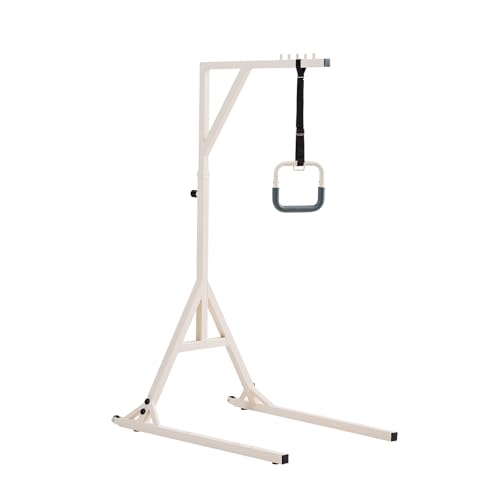
The VEVOR bed trapeze is a freestanding alternative among pull up bars for seniors, offering a larger frame for bed transfers and repositioning. Its adjustable height, handle strap, and wheeled base are designed for home care, nursing homes, and hospital-style use.
Best For: Users with limited mobility who need a freestanding aid for getting in or out of bed or transferring to a wheelchair.
Pros:
Heavy-duty Q195 steel frame supports up to 300 pounds.
Height and handle position adjust for different users and beds.
Reinforced base and top structure are designed to reduce wobbling.
Two casters make the 42.6-pound unit easier to move.
Cons:
Its freestanding frame requires more floor space than a bed ladder.
At 42.6 pounds, it is less portable than compact assist devices.
Assembly is required.
This VEVOR model is suited to users who need more substantial, adjustable support than a strap-based ladder provides. Its floor-standing design adds versatility, though shoppers should confirm that the base fits beneath and around their bed.
The Liberty Lift is a handheld standing aid rather than a permanently installed bar. For pull up bars for seniors shoppers, it offers grippy handles and a solid molded body to help two people assist a user with standing in indoor, outdoor, or vehicle settings.
Best For: Assisted standing after procedures such as knee replacement, or for seniors and disabled users who have two capable helpers.
Pros:
Rubberized grips help reduce hand slippage.
Compact, lightweight design is suitable for indoor, outdoor, and car use.
Listed weight capacity is 450 pounds.
Can stand independently when connected to a strong rope through its small hole.
Cons:
It requires two people to operate.
One helper must have sufficient strength to prevent an unsafe lift.
It is not a freestanding or permanently installed support bar.
The Liberty Lift makes sense when caregivers need a portable grip point for coordinated standing assistance. It is not intended for solo lifting, so it should be used only when adequate help is available.
For seniors comparing pull up bars for seniors, this wall-mounted medical trapeze is designed specifically for bed mobility rather than general doorway exercise. It helps users sit up, reposition, and transfer between a bed and chair, with adjustable reach and multiple locking angles.
Best For: Seniors or adults with limited mobility who need fixed bedside assistance and have a suitable concrete or load-bearing wall.
Pros:
Adjustable bar length from 18 to 30 inches and pull-ring height from 7.5 to 28 inches.
Five preset pulling angles support different transfer positions.
Heavy-duty steel construction supports up to 200 pounds.
Folds flat against the wall when not in use and includes a widened comfort-grip ring.
Cons:
Requires secure installation into concrete or a load-bearing wall.
Drywall or stud-wall installations require alternative hardware or a mounting board.
Not suitable for hollow brick or lightweight partitions.
This is a specialized choice for bedside transfers, not a freestanding pull-up station. Confirm the wall structure and installation method before purchase, particularly when dependable support is essential.
The Stander CouchCane is a practical alternative for shoppers seeking pull up bars for seniors who need leverage when rising from a couch, chair, or recliner. Its adjustable base fits compatible four-legged furniture, while the ergonomic handle provides a stable gripping point for sitting and standing.
Best For: Seniors and adults who need stand-assistance support beside compatible furniture rather than a bedside or wall-mounted transfer aid.
Pros:
Adjusts from 31 to 40.5 inches in handle height.
Base length adjusts from 17 to 33 inches to fit many chairs and couches.
Supports up to 250 pounds with a comfortable ergonomic grab handle.
Can help users sit, stand, and transfer with less caregiver assistance.
Cons:
Not intended for freestanding use; the base must sit beneath compatible furniture.
Furniture must have four legs and be 17 to 33 inches deep.
At 19 pounds, it is less portable than a simple grab handle.
Choose the CouchCane when the main challenge is getting up from seated furniture. Measure the furniture first and verify that its legs and depth match the stated compatibility range.
For seniors evaluating pull up bars for seniors in home-care settings, this VEVOR trapeze bar provides a freestanding bedside support option. Its adjustable frame and strap help users reposition, get in and out of bed, or transfer to a wheelchair without requiring wall mounting.
Best For: Bedridden users, seniors, and caregivers who need a movable floor-standing trapeze that can fit beneath various bed types.
Pros:
Heavy-duty Q195 steel frame has a stated capacity of up to 350 pounds.
Adjustable overall height, handle height, and strap position.
Triangular supports are designed to reduce wobbling and tilting.
Two casters make the 39.5-pound unit easier to move.
Cons:
Its large frame measures approximately 43.7 inches wide and 68.7 inches high.
At 39.5 pounds, it is heavier than wall-mounted alternatives.
Assembly is required, even though complicated tools are not needed.
This model suits users who want adjustable bedside support without drilling into a wall. Check available floor space and bed compatibility, and account for its substantial size and weight before choosing it for a home.
For shoppers comparing pull up bars for seniors, the AOSSA Bed Trapeze is a space-saving ceiling-mounted option designed for bed mobility. Its handle and adjustable strap can help with pulling up, repositioning, and transferring from bed.
Best For: Seniors or individuals with limited mobility who need bed-based assistance and have a suitable ceiling for secure mounting.
Pros:
Ceiling-mounted design avoids a bedside frame or floor support and reduces clutter.
Adjustable 45- to 68-inch strap is intended for ceilings 90 to 110 inches high.
Wide 9-inch handle supports a two-handed grip and the strap is rated for up to 350 pounds.
Cons:
Requires secure ceiling installation and checking the ceiling’s weight capacity first.
Not a free-standing option, so it may not suit renters or rooms without an appropriate mounting point.
This is a compact choice when overhead mounting is practical. Verify ceiling structure, height, and installation requirements before relying on it for transfers.
Among pull up bars for seniors, this free-standing bed trapeze emphasizes adjustability and mobility. Its carbon-steel frame, wide base, adjustable pull positions, and braked casters are designed to assist with sitting up, repositioning, and transfers.
Best For: Home-care users who want a movable bedside assist bar with adjustable height and a broad base.
Pros:
Height adjusts from 35.4 to 74.8 inches, with multiple pull-rod positions.
Wide 36-by-24-inch base and carbon-steel construction support up to 330 pounds.
Swivel casters with brakes make positioning and securing the unit more convenient.
Includes a lanyard, gloves, wheels, and an English installation diagram.
Cons:
At 29.7 pounds, it is less lightweight than a simple mounted handle.
The sizable base requires adequate floor space beside or around the bed.
This model offers a practical balance of adjustability and portability for home care. Confirm that the base can fit securely in the intended bedside area and follow the assembly instructions carefully.
The VEVOR Bed Trapeze Bar is a floor-standing alternative for shoppers seeking pull up bars for seniors. Its Q195 steel frame, adjustable handle and strap, and reinforced base are intended to provide support for getting up, repositioning, and transferring.
Best For: Home-care, nursing-home, or hospital settings where a sturdy floor-mounted assist bar can remain beside the bed.
Pros:
Heavy-duty steel frame is rated for up to 250 pounds.
Adjustable strap height and horizontal strap positions allow grip customization.
Reinforced triangular supports are designed to reduce wobbling or tilting.
Can be secured to the floor using the base’s screw holes and included anchor hardware.
Cons:
Its 250-pound capacity is lower than the other listed trapeze options.
Floor anchoring may be unsuitable where permanent installation is not desired.
At 33.3 pounds, it is not especially easy to relocate frequently.
This is a stability-focused option for a dedicated bedside setup. Measure the 38-inch-wide footprint and ensure floor anchoring is appropriate before installation and use.
We focused on products designed to help older adults reposition, sit up, stand, or transfer with added support. The selection includes portable and free-standing designs as well as products intended for beds, couches, bathrooms, and other common home settings.
We compared construction, handle design, adjustment options, stated weight capacity, footprint, installation requirements, and the type of assistance each product provides. Because mobility needs vary widely, no single design is ideal for every senior.
Quick Comparison
Bed ladders and overhead trapeze bars are generally best for users who need help sitting up or changing position in bed. Free-standing trapeze systems can offer more versatility but require adequate floor space and a level surface. Couch canes and standing aids are better suited to rising from seated furniture, while shower grab bars are intended for bathroom support rather than lifting the full body.
Always verify the product’s dimensions, mounting method, and weight rating against the user’s needs. A stated capacity is not a guarantee of safety if the device is installed incorrectly or used for an unintended movement.
Key Buying Factors for Pull-Up Bars for Seniors
Stability and Installation
Look for a broad, secure base on free-standing models and dependable hardware on mounted products. Bedside devices should not slide, tip, or interfere with wheels, rails, mattresses, or adjustable-bed mechanisms.
Handle Comfort and Reach
Non-slip grips, suitable handle thickness, and an adjustable height or length can make a major difference for users with limited hand strength or range of motion. The handle should be reachable without excessive stretching or twisting.
Weight Capacity and User Fit
Choose a model with a comfortably higher rated capacity than the user’s weight, while also considering body position and the force created during transfers. Check the manufacturer’s dimensions, especially for taller users or thicker mattresses.
Portability and Space
Portable ladders are convenient for travel and simple setups. Free-standing trapezes need more room but may support multiple bed-transfer positions. Measure the intended area before ordering.
Safety and Professional Guidance
These products are mobility aids, not substitutes for clinical assessment. A healthcare professional or occupational therapist can help determine whether a pull-up aid, transfer pole, bed rail, or another device is appropriate. Stop using any product that shifts, bends, loosens, or causes pain.
Who Should Buy Which Pull Up Bars for Seniors?
Choose a bed ladder if the main challenge is sitting up or repositioning in bed and the user can pull with their arms. Select a free-standing or mounted trapeze bar for more substantial bedside assistance, provided the setup is compatible with the room and bed.
A couch-assist device is the better match for someone who struggles to rise from a sofa or recliner. For bathroom entry and balance support, use a properly installed grab bar rather than a device designed for bed mobility. When the user cannot safely bear weight through their arms or needs hands-on transfer help, consult a clinician before purchasing.