Training alone is easier when a table tennis robot can deliver repeatable balls, varied spins, and adjustable placement on demand. The best options under $300 range from simple rebound trainers to app-controlled machines with extensive drill libraries.
This roundup compares 10 affordable robots by control options, recycling setup, ball capacity, portability, and practice flexibility so you can choose a model that fits your table, skill level, and training goals.
Best 10 Table Tennis Robots Under 300 Picks for 2026
Versatile Spin Trainer

- Produces 36 kinds of spinning balls
- Supports topspin, backspin, and sidespin
- Portable design with approximately 110-ball capacity
Best For: Spin-focused solo practice with simple setup
Remote-Control Value Pick

- Includes wireless control for training adjustments
- Supports direct and indirect serving angles
- Adjusts spin, speed, frequency, and oscillation
Best For: Flexible solo drills on tables under 2.5 inches thick
Smart Drill Specialist

- Includes 522 preset and customizable training drills
- Offers app and remote control
- Holds 150 balls and provides nine spin types
Best For: Structured, customizable training for players and coaches
Ball-Recycling Practice Setup
Suz S201 Robot with Net and 200 Balls

- Includes recycling net and 200 balls
- Provides spin, speed, and oscillation options
- Adjusts for direct or indirect serves
Best For: Continuous solo practice with less ball pickup
Feature-Packed Pick
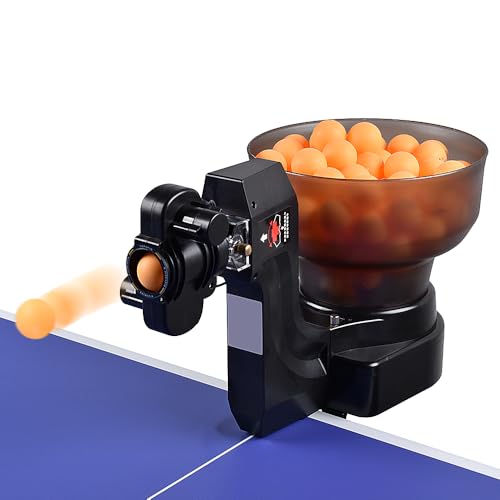
- Nine spin modes and 8.9–76 mph speed range
- 120-ball hopper with automatic oscillation
- Two-year warranty and clamp for tables up to 2.5 inches
Best For: Adjustable solo practice with varied spin and placement
Simple Portable Pick

- Wireless operation with four AA batteries
- Launches up to 30 balls per minute
- Includes 20 40mm ABS training balls
Best For: Beginner-friendly practice at home or on the go
Drill-Focused Pick

- 264 pre-saved drills plus custom drills
- Remote and smartphone-app control
- Includes a ball recycling net
Best For: Structured and personalized solo training
Best All-Around Pick

- Adjustable speed, frequency, direction, and spin
- Wireless remote with memory button
- Serves 30 to 70 balls per minute
Best For: Versatile solo practice for beginners, families, and developing players
Best Simple Rebound Trainer

- Compact table-clip design
- Rapid rebound for stroking practice
- Includes five practice balls
Best For: Portable, uncomplicated repetitive-stroke training
Best Smart Training Features
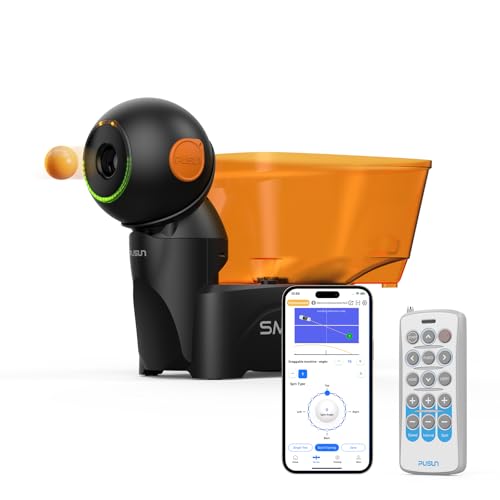
- 200+ preset training drills
- Remote and app control
- Triple-motor spin and landing adjustment
Best For: Structured, customizable solo training with broad serve variety
Versatile Spin Trainer – 36-Spin Ping Pong Robot
If you want table tennis robots under 300 for basic solo practice, this machine focuses on varied spin and straightforward setup. It can produce topspin, backspin, sidespin, and combinations, while its compact design makes it easier to carry and position.
Best For: Players who want a portable robot centered on spin variety and adjustable placement.
Pros:
- Offers 36 different spinning-ball combinations.
- Supports optional single or double-end serving.
- Holds approximately 110 balls in its container.
- Includes a one-year warranty for product-quality issues under normal use.
Cons:
- 40 mm international-standard balls are required and are not included.
- At least 15 balls must be loaded for the machine to serve.
- The falling point is not fixed, which may be less suitable for highly repeatable placement drills.
This is a practical choice when spin experimentation matters more than advanced electronic programming. Remember to budget for compatible balls and load enough of them before training.
Remote-Control Value Pick – Suz S102 Wireless Trainer
Among table tennis robots under 300, the Suz S102 is aimed at players who want wireless control over solo drills without a practice partner. Its remote adjusts training variables, while the robot head can be positioned for direct or indirect serves.
Best For: Players seeking an adjustable remote-controlled trainer for topspin, backspin, speed, frequency, and oscillation practice.
Pros:
- Wireless remote control supports adjustable training settings.
- Robot head adjusts up and down for direct or indirect serving.
- Designed to help vary spin, speed, and drills during solo practice.
- Manufacturer provides free replacement parts for normal wear and tear within one year.
Cons:
- Only fits tables less than 2.5 inches thick.
- Requires at least 20 balls in the storage tube for proper operation.
- Some setup and oscillation adjustments may require following the manual or contacting the manufacturer.
The S102 makes sense for players who value remote adjustments and flexible serve angles. Check your table thickness and follow the setup guidance carefully, especially if ball delivery is weak or inconsistent.
Smart Drill Specialist – PONGBOT NOVA S Pro App Robot
For shoppers comparing table tennis robots under 300, the PONGBOT NOVA S Pro stands out for app-based programming and extensive drill options. It combines remote or app control with adjustable speed, frequency, spin, rotation, and landing-point settings.
Best For: Beginners, advanced players, and coaches who want structured or customizable solo training.
Pros:
- Offers 522 built-in preset training drills plus custom drill programming.
- App and remote control adjust spin, speed, frequency, height, and landing point.
- Provides nine spin types, 21 speed levels, and 21 rotation levels.
- 150-ball capacity supports longer practice sessions with less frequent refilling.
Cons:
- 40 mm or larger table tennis balls and two AAA batteries are not included.
- App features and installation require consulting the app materials and user manual.
- Its advanced controls may be more than casual players need.
This is the strongest fit for structured skill development and precise drill customization. Its app-based landing animation and large drill library are useful when you want practice sessions to be repeatable and targeted.
Ball-Recycling Practice Setup – Suz S201 Robot with Net and 200 Balls
If convenience matters when comparing table tennis robots under 300, the Suz S201 pairs a training robot with a recycling net and 200 balls. The setup is designed to return balls toward the feeding tube, reducing the need to stop and collect them between drills.
Best For: Players who want a complete ball-recycling setup for continuous solo practice.
Pros:
- Includes a machine recycling net and 200 balls.
- Offers options for spin, speed, and oscillation.
- Robot head adjusts for direct or indirect serves.
- Ball recycling helps reduce manual pickup during practice.
Cons:
- Only fits tables less than 2.5 inches thick.
- Requires at least 20 balls around the feeding tube for proper serving.
- Net tension and tilt may need adjustment to guide balls into the feeder.
The S201 is a practical option when minimizing interruptions is the priority. Its included ball supply and recycling net make it more self-contained, though table compatibility and correct net setup are important.
Feature-Packed Pick – WAYMARK HP-07
If you want one of the more adjustable table tennis robots under 300, the WAYMARK HP-07 offers nine spin modes, variable speed, and automatic oscillation. Its 120-ball hopper supports longer solo sessions, while the clamp-on design fits tables up to 2.5 inches thick.
Best For: Players who want varied spin, speed, and placement practice at home or in a club.
Pros:
- Dual motors support nine spin variations and speeds from 8.9 to 76 mph.
- 120-ball hopper enables extended practice with fewer reloads.
- Adjustable pitch, sidespin, and oscillation create varied drills.
- Includes a two-year warranty and tool-free table clamp.
Cons:
- Ball catch net is sold separately.
- Its broad adjustment range may be more than beginners need.
The HP-07 is a strong choice when training variety matters most. It is more feature-oriented than a basic launcher, but you will need a separate catch net for a fully contained setup.
Simple Portable Pick – JOOLA iPong Play
JOOLA iPong Play Table Tennis Trainer Robot with 20 ABS Training Balls, Orange
Check Price On AmazonThe JOOLA iPong Play is a straightforward option among table tennis robots under 300, especially for beginners who want quick setup. It runs on four AA batteries, arrives assembled, and can launch up to 30 balls per minute without an app or power outlet.
Best For: Beginners, casual players, and families seeking a compact practice launcher.
Pros:
- Battery-powered and wireless for flexible placement.
- Arrives assembled and starts with a simple power switch.
- Includes 20 quality-checked 40mm ABS training balls.
- Compact design is easy to store or take on the go.
Cons:
- Four AA batteries are required and not included.
- Its 30-ball-per-minute output is geared toward entry-level practice.
- The supplied notes do not mention spin or oscillation controls.
Choose the iPong Play for convenience rather than advanced programming. Its simple operation and portable design make it approachable, though experienced players may want more training controls.
Drill-Focused Pick – PONGBOT NOVA S Pro
The PONGBOT NOVA S Pro stands out among table tennis robots under 300 for its extensive drill library and connected controls. It includes a recycling net, supports remote or smartphone-app operation, and offers 264 pre-saved drills plus custom-drill creation.
Best For: Players who want structured training and the ability to build personalized practice routines.
Pros:
- Provides 264 pre-saved drills for varied training.
- Allows users to create custom drills.
- Offers both remote and smartphone-app control.
- Includes a ball recycling net for easier setup.
Cons:
- The supplied notes do not specify spin, speed, or ball-capacity adjustments.
- It weighs 4 kg, making it less lightweight than compact launchers.
- Warranty coverage is one year.
For drill-focused practice, the NOVA S Pro offers more programming flexibility than a basic launcher. Its included net and dual-control options also make repeated sessions easier to organize.
Best All-Around Pick – iPong V300
For shoppers comparing table tennis robots under 300, the JOOLA iPong V300 is a practical solo-training option with adjustable speed, frequency, direction, and spin. It sets up quickly, requires no app, and can serve up to 70 balls per minute.
Best For: Beginners, families, and players who want versatile solo practice with wireless control.
Pros:
- Adjusts ball speed, frequency, direction, topspin, and backspin.
- Wireless remote includes memory functionality for practice adjustments.
- Fast assembly without app downloads or complicated instructions.
- Serving rate adjusts from 30 to 70 balls per minute.
Cons:
- The supplied details do not specify included balls or additional accessories.
- It is designed for one player, so it does not replace two-person play.
The V300 stands out as a balanced choice when you want broad training adjustments and straightforward operation in a compact robot.
Best Simple Rebound Trainer – Fixed Rapid Rebound Trainer
Among table tennis robots under 300, this compact fixed rebound trainer offers a simple, low-weight approach to stroking practice. Its table-clip design uses a rapid-rebound mechanism and includes both copper-hole and ordinary balls.
Best For: Players seeking a basic, portable stroking trainer rather than an electronically programmable robot.
Pros:
- Compact design weighs about 10.6 ounces.
- Table clip accommodates thicknesses up to 6.5 cm.
- Rapid rebound supports repeated stroking practice.
- Package includes two copper-hole balls and three ordinary balls.
Cons:
- Fixed rebound design does not list adjustable speed, spin, or frequency controls.
- No remote, app, or electronic serving functions are specified.
- It may provide less serve variety than a programmable ball machine.
This is best viewed as a straightforward mechanical practice aid for repetitive strokes, especially when portability and simplicity matter more than advanced drills.
Best Smart Training Features – Dora Smart Pro
For buyers exploring table tennis robots under 300 with more structured practice options, the Dora Smart Pro combines remote and app control with more than 200 preset drills. Its triple-motor system is designed to adjust spin, speed, landing location, and serving patterns.
Best For: Players who want guided drills, broad table coverage, and customizable solo sessions.
Pros:
- Includes more than 200 pre-saved training drills.
- Remote and app control support customized practice.
- Triple-motor launching system adjusts spin, speed, frequency, and landing.
- Designed for full-court coverage and variable serve combinations.
Cons:
- The supplied notes list conflicting warranty durations of three years and 1.5 years.
- App-based control may require more setup than a basic switch-operated robot.
- The listed dimensions are substantial, so buyers should confirm available space.
The Smart Pro is the feature-heavy option in this group, particularly appealing if preset drills and detailed serve customization are central to your training routine.
How We Picked the Best Table Tennis Robots Under 300
We focused on the features that matter most during solo practice: ball delivery consistency, spin and speed adjustment, placement control, setup time, and overall training versatility. We also considered whether each robot includes a collection net or recycling system, how many balls it can hold, and whether controls are handled by a remote, onboard panel, or mobile app.
Because budget robots vary widely, we separated basic automatic feeders from models designed for structured drills. Product specifications, included accessories, portability, and the likely learning curve all informed the comparison. Prices and included equipment can change, so confirm current details before ordering.
Quick Comparison
| Feature | What to Look For |
|---|---|
| Control method | Remote controls are simple; app control often provides more drill customization. |
| Ball capacity | Higher capacity means fewer interruptions during longer sessions. |
| Ball recycling | A net or recycling system reduces time spent collecting balls. |
| Training variety | Preset drills, spin settings, and placement adjustments support more progressive practice. |
| Portability | Compact designs are easier to store, transport, and set up on different tables. |
Key Buying Factors for Table Tennis Robots Under $300
Spin, Speed, and Placement Controls
Choose a robot with independent adjustments for speed, frequency, and spin if you want to practice more than basic forehand and backhand strokes. Preset drills can make training easier, while customizable settings are better for players working on specific weaknesses.
Ball Capacity and Recycling
A small hopper may be adequate for short sessions, but larger capacities are more convenient for repetitive footwork or consistency work. Models with a collection net can save substantial time, especially when practicing alone.
Controls and Drill Programming
Remote control is useful for quick changes between points. App-based systems may offer more presets and custom sequences, but they can require a compatible phone and additional setup. Check whether the app is currently supported for your device.
Table Fit and Storage
Measure your table and available storage area before buying. Desktop and compact robots suit smaller spaces, while net-based systems need room behind or around the table. Also verify that the unit works with standard 40mm balls if regulation-size practice is important.
Who Should Buy Which Table Tennis Robots Under 300?
Choose a basic feeder if you want an affordable way to repeat simple strokes without complicated programming. These models are often quickest to set up and easiest to store.
Choose a recycling-net model if you practice frequently and dislike stopping to collect balls. The extra setup is worthwhile for high-volume drills and longer sessions.
Choose an app-controlled robot if you want preset drills, detailed customization, and a more structured training plan. These are especially useful for intermediate players who need varied placement and spin.
Choose a compact desktop unit if portability and limited storage matter most. It may offer fewer advanced features, but it can be the most practical choice for casual practice or smaller rooms.
Related Posts: