The best battle ropes can turn a small home-gym setup into a versatile conditioning station. They support waves, slams, pulls, and intervals that challenge your arms, shoulders, core, grip, and cardiovascular fitness.
This roundup compares traditional anchored ropes with portable cordless and weighted alternatives, so you can choose equipment that fits your training space, goals, and available storage.
If you want a conventional battle rope for strength, cardio, CrossFit, and full-body conditioning, this Amazon Basics model offers a practical 30-foot setup. Its 1.5-inch polyester construction, protective sleeve, and heat-shrink end caps are designed for regular training use.
Best For: Home-gym users seeking a traditional battle rope for varied conditioning workouts.
Pros:
Durable 100% Poly Dacron, three-strand twisted construction
600D Oxford waterproof sleeve helps protect against wear
Heat-shrink end caps help reduce fraying
Orange/yellow tracking line improves visibility for maintenance and safety
Cons:
At 30 feet and 1.5 inches, it offers fewer size options than some alternatives
The traditional rope format requires suitable workout space and an anchor point
This is a straightforward choice for buyers who prefer the feel and setup of a full-length battle rope, with useful protective details for ongoing home-gym training.
This ropeless battle rope is designed for users who need a compact, quiet alternative to a traditional rope. The steel core provides weighted resistance, while eight adjustable weight rings let you change the training load for HIIT, strength work, and low-impact cardio.
Best For: Apartment dwellers, travelers, and beginners who want adjustable battle-rope-style training without floor drag or noise.
Pros:
Portable cordless design includes a storage bag and workout guide
Steel core delivers weighted resistance without a long rope
Ergonomic anti-slip handles use a threaded locking design
Cons:
It does not provide the same long-rope setup as a traditional battle rope
The workout experience depends on adjusting and managing the included weight rings
For small spaces, this set prioritizes portability and adjustable resistance. It is a useful option when a conventional anchor-and-rope arrangement is impractical.
The Perantlb Poly Battle Rope gives you more setup flexibility than a single-size model, with 30-, 40-, and 50-foot lengths and multiple diameter options. A protective sleeve and long rubberized handles support demanding home-gym conditioning and muscle-toning workouts.
Best For: Users who want to choose rope length and diameter to vary workout intensity.
Pros:
Available in 30-, 40-, and 50-foot lengths
Offers 1.25-, 1.5-, and 2-inch diameter options
Wear-resistant sleeve helps reduce friction and fraying
8.66-inch heat-shrink handles provide a non-slip rubber grip
Cons:
Larger diameter and longer configurations may be more demanding to handle
The traditional rope design needs adequate space and an anchor setup
This is a strong fit for households or training partners with different preferences. The available sizes make it easier to tailor resistance and handling to your workout style.
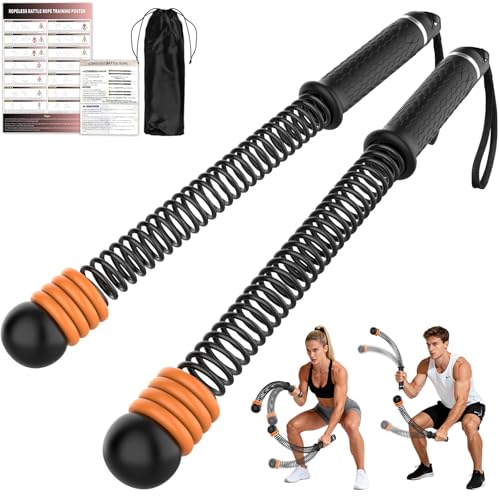
The COCTN Cordless Battle Rope is a compact weighted alternative for home, park, or gym workouts. Its steel construction, sweat-absorbing handles, safety features, and included poster make it suitable for users who want portable cardio, HIIT, strength, and forearm training.
Best For: Beginners and fitness enthusiasts who want guided, portable battle-rope-style training.
Pros:
Compact cordless design is easy to carry and store
Weighted steel construction operates silently during workouts
Ergonomic rubber handles use a threaded connection for a secure fit
Includes an instruction manual, training poster, safety ropes, and top nuts
Cons:
It offers a different experience from swinging a full-length traditional rope
The compact 7-inch listed item length may not suit buyers seeking extended rope movement
Choose this model when portability, quiet operation, and included guidance matter more than a conventional anchored battle-rope setup. Its compact format makes it convenient for flexible training locations.
These cordless battle ropes are designed for people who want battle rope-style training without a long rope, anchor point, or large workout area. The weighted spring-core design provides resistance for HIIT, cardio, strength work, and full-body movements, while the compact format suits apartments and travel.
Best For: Home gyms, small spaces, travel workouts, and users who want a versatile ropeless setup.
Pros:
Compact cordless design eliminates bulky ropes and anchors.
Includes five resistance bands, gloves, and two rope-style handles.
Supports HIIT, cardio, strength training, and dual-rope or fitness-bar exercises.
Non-slip ergonomic handles and balanced weighting are designed for comfortable use.
Cons:
Does not provide the same long-rope setup as a traditional anchored battle rope.
The adjustable, compact design may feel different from a full-length rope.
This is a practical choice when portability and space efficiency matter more than replicating a conventional 30-foot rope. Its included accessories add exercise variety, making it especially appealing for compact home workouts.
This 30-foot battle rope is the conventional choice for users who have room to anchor a full-length rope. Its 1.5-inch polyester construction, protective cover, heat-shrink handles, and included anchoring accessories are suited to demanding home or outdoor training.
Best For: Intermediate to advanced users seeking traditional anchored battle rope workouts indoors or outdoors.
Pros:
Durable three-strand polyester rope includes a nylon protective outer cover.
Heat-shrink handles are designed to improve grip during intense sessions.
Includes anchors and straps for tree, pole, or other fixed-point setups.
Supports waves, pulls, climbing movements, and full-body conditioning.
Cons:
The 30-foot rope requires substantial workout space and a secure anchor point.
At 14.5 pounds, the 1.5-inch version may be demanding for beginners.
Its traditional design is less portable than cordless alternatives.
Choose this model if you specifically want the feel and setup of a standard battle rope. The 1.5-inch, 30-foot configuration is positioned for intermediate-to-advanced training, while the listed range also includes lighter and heavier versions.
These cordless battle ropes simulate rope movement with compact weighted handles, making them useful when floor space or portability is a concern. The movable weight position lets you adjust intensity for arm, shoulder, back, core, HIIT, and lower-impact training.
Best For: Beginners and experienced users who want adjustable resistance for indoor, travel, or outdoor workouts.
Pros:
Ropeless format is compact and easy to carry.
Adjustable weight position allows intensity changes for different fitness levels.
Ergonomic non-slip handles help with control during fast workouts.
Designed for smooth, quiet motion in small workout areas.
Cons:
It does not offer the long-rope anchoring experience of a traditional battle rope.
As a single-item cordless system, it may provide a different feel from paired full-length ropes.
This model is a strong fit for flexible home training, particularly if you want to vary resistance without storing a long rope. Its compact stainless-steel construction and quiet motion also make it practical for indoor sessions.
This battle rope is built for demanding home-gym, garage, and outdoor workouts. Its 1.5-inch, 30-foot polyester construction combines a protective nylon sleeve with substantial weight, making it a strong option for rope slams, waves, pulls, and full-body conditioning.
Best For: Intermediate to advanced users who want a durable, heavy battle rope for strength, endurance, and circuit training.
Pros:
Heavy-duty three-strand polyester construction with a friction-resistant nylon sleeve.
Thick heat-shrink handles are designed to maintain a secure grip during sweaty workouts.
Includes a rust-resistant anchor strap kit for posts, trees, and other stable fixtures.
Supports full-body exercises involving the arms, shoulders, core, back, and legs.
Cons:
The heavier build may be more challenging for beginners.
At 30 feet and 7 kg, it requires suitable storage and a secure anchor point.
Choose this model if durability and resistance matter more than portability. The sleeve and anchor kit add practical protection and setup flexibility, while the 1.5-inch diameter suits users ready for more demanding rope training.
This 1-inch, 30-foot battle rope offers a practical way to add waves, pulls, and other conditioning drills to a home or outdoor workout. Its nylon sleeve helps protect the three-strand polyester rope from friction, and the rope can be rolled up for compact storage.
Best For: Home-gym users and outdoor trainees seeking a portable battle rope with a manageable 1-inch diameter.
Pros:
Protective nylon sleeve helps reduce friction damage and fraying.
Non-slip handle design supports a more secure grip during exercise.
Rolls up for easier storage and portability.
Can be attached to trees, fixed posts, or outdoor fitness equipment with accessories.
Cons:
The 1-inch diameter may provide less resistance than thicker battle ropes.
The supplied notes do not specify an included anchor kit.
This is a sensible choice when storage and transport are priorities. It still supports total-body training for athletes and general fitness users, while its slimmer design may be easier to handle than heavier alternatives.
This 1.5-inch, 30-foot battle rope is designed for home-gym and outdoor training, with a nylon protective sleeve over three-strand polyester fibers. The thicker profile makes it a useful option for waves, pulls, climbing drills, and other full-body exercises.
Best For: Users who want a thicker battle rope for versatile conditioning workouts and outdoor training sessions.
Pros:
1.5-inch diameter offers a substantial rope profile for training.
Nylon sleeve helps protect against friction, including outdoor surface wear.
Three-strand polyester construction is designed to resist loosening and deformation.
Non-slip handles help protect the hands and maintain grip.
Cons:
The 30-foot length requires enough open workout space.
The supplied details list the product color inconsistently, so verify the selected variant before ordering.
This model fits shoppers looking for a thicker rope without moving beyond a standard 30-foot length. Its sleeve, polyester construction, and versatile attachment options make it suitable for both indoor and outdoor conditioning, provided you have a secure anchor point.
We evaluated these Battle Ropes by comparing the features that matter most during repeated high-intensity workouts: rope diameter, length, construction, handle comfort, weight, portability, anchoring requirements, and setup needs. We also considered whether each design suits a dedicated home gym or a flexible workout space where drilling an anchor point is not practical.
Traditional ropes generally provide a familiar feel and continuous resistance when attached to a secure anchor. Cordless and weighted models offer greater portability, although their resistance comes from internal weights, bands, or user movement rather than a fixed anchor. Product descriptions should be checked carefully for included accessories, exact dimensions, and resistance components.
Quick Comparison
Type
Best For
Main Advantage
Key Trade-Off
Traditional anchored rope
Home gyms and serious conditioning
Natural wave and slam action
Needs a strong anchor and floor space
Thick, heavy rope
Strength, grip, and power training
Greater resistance and fatigue
Heavier and harder to store
Ropeless or cordless rope
Apartments, travel, and compact workouts
No permanent anchor required
Different movement feel and resistance profile
Weighted rope with bands or rings
Adjustable home training
Resistance can be tailored
More components to manage
Key Buying Factors for Battle Ropes
Length and Diameter
A 30-foot rope is a practical starting point for many home gyms. Longer ropes can create smoother waves but require more room. A 1-inch rope is easier to handle and better suited to conditioning, while 1.5-inch or 2-inch options increase grip and upper-body demands.
Construction and Handles
Look for a durable rope cover or sleeve, tightly secured ends, and handles that remain comfortable during intervals. A protective sleeve can reduce abrasion and help the rope withstand contact with flooring, but it does not replace a proper anchor and suitable training surface.
Space, Anchor, and Portability
Measure the available workout area before buying. Traditional Battle Ropes need a stable anchor that can withstand repeated pulling. Cordless designs are easier to move and store, making them useful when permanent installation is not possible.
Resistance and Adjustability
Heavier ropes increase the challenge, but they may limit workout duration and technique quality. Adjustable weighted or band-based systems can be more versatile for different users. Start with manageable resistance and progress gradually.
Who Should Buy Which Battle Ropes?
Choose a traditional 30-foot rope if you want classic waves, slams, and full-body conditioning in a dedicated workout area. Pick a thicker 1.5-inch or 2-inch model if grip strength and muscular endurance are priorities. A lighter 1-inch rope may be more comfortable for beginners or longer interval sessions.
Choose cordless or weighted Battle Ropes if you live in an apartment, travel frequently, or cannot install a permanent anchor. These options are also convenient for quick workouts, though users seeking the most authentic rope-wave experience may prefer a conventional anchored model. Whichever style you choose, inspect connections regularly, keep the training area clear, and use controlled movements rather than relying on speed alone.