Indoor training can make triathlon preparation more consistent when weather, traffic, or limited daylight gets in the way. The right trainer lets you build endurance, power, and race-specific fitness without leaving home.
This roundup compares 10 bike trainers for triathlons, from connected smart trainers with automatic resistance to simple magnetic stands designed for affordable steady riding.
Best 10 Bike Trainers for Triathlons Picks for 2026
Premium Smart Pick
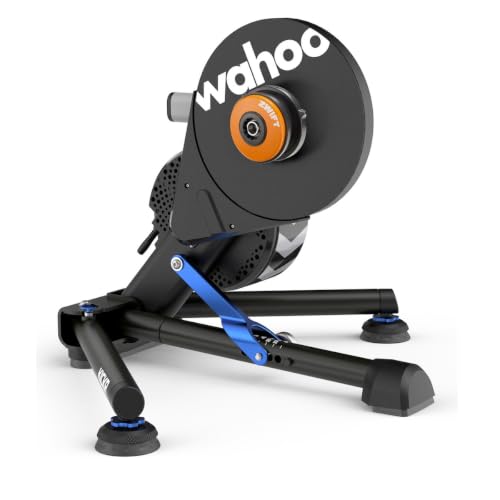
- Wi-Fi connectivity and smart training support
- 2,200W resistance with +/- 1% accuracy
- Automatic calibration and AXIS ride feel
Best For: Data-focused triathletes seeking precise, connected indoor training
Budget Magnetic Choice
BalanceFrom Bike Trainer Stand

- Eight manually adjustable magnetic resistance levels
- Wide, low frame with rubber feet
- Fits many road and mountain bikes
Best For: Simple, affordable indoor riding and conditioning
Connected Training Value
ThinkRider X2Max Smart Trainer

- ANT+ and BLE compatibility for training software
- 2,000W output with 18% slope simulation
- Quiet operation rated around 58 dB at 30 km/h
Best For: Virtual-course and gradient-focused indoor training
Portable Training Stand
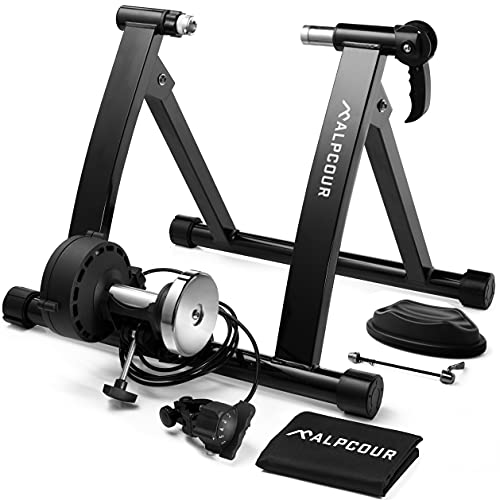
- Foldable frame with included carrying bag
- Six manually controlled resistance levels
- Fits most 26- to 28-inch and 700C wheels
Best For: Travel-friendly, low-complexity indoor cycling
Best Overall
Saris Fluid2 Indoor Bike Trainer

- Progressive fluid resistance feels road-like
- Foldable wheel-on design stores easily
- Compatible with Zwift and Rouvy with a sensor
Best For: Triathletes wanting smooth, app-compatible indoor training
Best Adjustable Magnetic
Sportneer 6-Level Bike Trainer

- Six handlebar-controlled resistance levels
- Fits many 26–28-inch and 700C wheels
- Includes quick-release hardware and riser block
Best For: Triathletes wanting simple, adjustable indoor workouts
Best Budget Stability
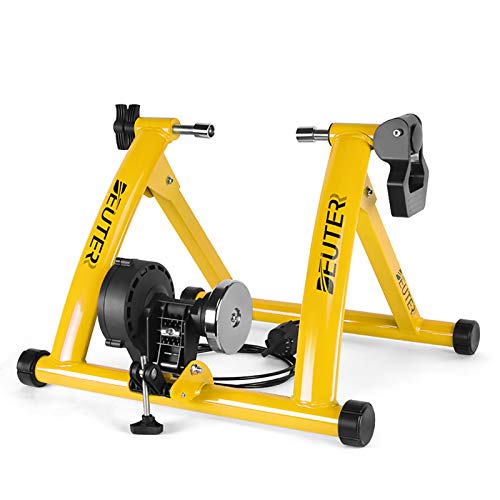
- Six handlebar-adjustable resistance levels
- Supports 26–29-inch wheels and 700C
- Folds for tool-free setup and storage
Best For: Triathletes needing a simple, space-saving indoor stand
Best All-Around Pick
Sportneer Magnetic Bike Trainer

- Six handlebar-controlled resistance levels
- Stable alloy-steel frame with anti-slip feet
- Fits 26–28-inch and 700C wheels
Best For: Versatile indoor triathlon training on compatible road or mountain bikes
Best High-Capacity Option
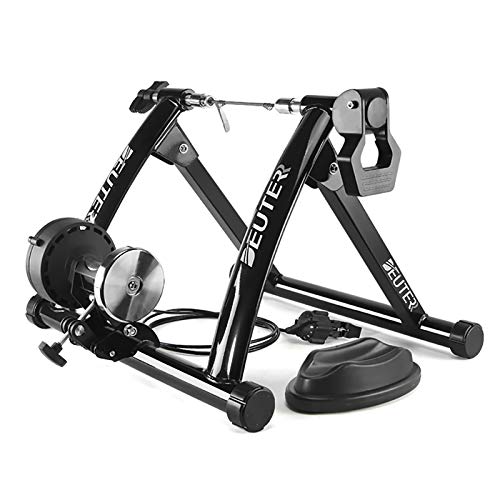
- 330-pound stated load capacity
- Six handlebar-adjustable resistance levels
- Folds for storage and transport
Best For: High-capacity indoor training setups with limited storage space
Best for Compact Storage
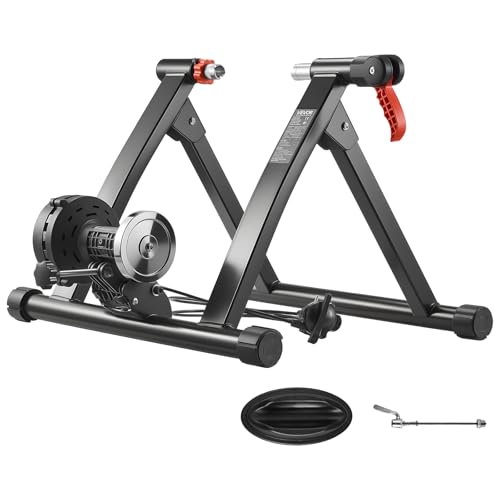
- Foldable carbon-steel frame
- Six resistance levels for varied sessions
- Fits 26–29-inch and 700C wheels
Best For: Portable indoor training with easy storage between workouts
Premium Smart Pick – Wahoo KICKR V6
For athletes comparing bike trainers for triathlons, the Wahoo KICKR V6 is a feature-rich direct-drive option built around stable connectivity and precise resistance control. Wi-Fi data transfer, automatic calibration, and up to 2,200 watts of resistance make it suited to structured indoor sessions.
Best For: Triathletes who want a high-performance smart trainer with strong connectivity and accurate power control.
Pros:
- Wi-Fi connectivity provides a stable connection for transferring ride data.
- Resistance reaches 2,200 watts and is rated accurate to within +/- 1%.
- Automatic calibration helps maintain consistent power accuracy.
- AXIS feet and the high-inertia flywheel provide a more outdoor-like ride feel.
Cons:
- At 18 kg, it is relatively heavy to move and store.
- Its advanced feature set may be more than needed for basic indoor riding.
- The included warranty is listed as one year.
The KICKR V6 is the strongest choice here for demanding, data-focused training. Its power capacity, connectivity, and calibration-free operation support interval work and repeatable preparation for race day.
Budget Magnetic Choice – BalanceFrom Bike Trainer Stand
BalanceFrom Bike Trainer Stand Steel Bicycle Exercise Magnetic Stand with Front Wheel Riser Block
Check Price On AmazonIf you want straightforward bike trainers for triathlons without smart features, the BalanceFrom magnetic stand offers adjustable resistance in a simple, stable format. It fits road and mountain bikes with 26- to 28-inch or 700C wheels and includes a handlebar-mounted controller.
Best For: Budget-conscious triathletes who need basic indoor endurance, conditioning, or interval training.
Pros:
- Eight magnetic resistance settings allow adjustments for speed and effort.
- Wide base, low stance, and rubber feet support stability on different surfaces.
- Quick-release clamp makes installation and bike removal easier.
- Supports a listed maximum load of 330 pounds.
Cons:
- Rough tires can produce noticeable load noise.
- It does not provide the connected power or automatic resistance features of a smart trainer.
- Resistance is adjusted manually from the handlebar controller.
This trainer is a practical entry point for maintaining cycling volume indoors. It is best when simplicity, compatibility, and a lower-complexity setup matter more than virtual training integration.
Connected Training Value – ThinkRider X2Max Smart Trainer
The ThinkRider X2Max is a smart option among bike trainers for triathlons, combining ANT+ and BLE support with software-compatible variable resistance. It can simulate gradients up to 18% and delivers up to 2,000 watts, giving athletes useful capacity for virtual courses and structured workouts.
Best For: Triathletes seeking software-connected training and realistic gradient simulation at a potentially lower complexity than premium models.
Pros:
- ANT+ and BLE support works with mainstream cycling software such as Zwift.
- Up to 2,000 watts of power and 18% simulated slope support challenging sessions.
- Listed noise level is about 58 dB at 30 km/h.
- I-beam triangular construction is designed for riding stability.
Cons:
- The cassette is not included.
- Power accuracy is listed at +/- 2%, less precise than the Wahoo option.
- The listed load capacity is 240 pounds.
With dual wireless protocols and automatic gradient matching, the X2Max is well suited to athletes who train through virtual routes or structured software workouts. Remember to account for the separate cassette requirement when planning the setup.
Portable Training Stand – Alpcour Magnetic Bike Trainer
For triathletes who need flexible bike trainers for triathlons, the Alpcour magnetic stand provides a portable way to turn a road or mountain bike into an indoor stationary setup. Its six resistance levels, front wheel riser, foldable frame, and included carrying bag suit home use and travel.
Best For: Cyclists who prioritize portability, basic resistance control, and easy storage.
Pros:
- Six handlebar-controlled resistance levels cover flat-to-steep simulated efforts.
- Foldable stainless-steel frame and included bag simplify transport and storage.
- Front wheel riser and anti-slip rubber pads support a stable setup.
- Compatible with most 26- to 28-inch and 700C wheels.
Cons:
- As a magnetic stand, it does not offer smart connectivity or software-controlled resistance.
- Resistance depends on tire contact with the flywheel.
- The listed load capacity range tops out at 250 pounds.
The Alpcour makes the most sense for athletes who want a conventional trainer they can pack away between sessions. It offers useful manual resistance and broad wheel compatibility, but not the power data or automatic control of smart models.
Best Overall – Saris Fluid2 Indoor Bike Trainer
For triathletes seeking bike trainers for triathlons, the Saris Fluid2 offers a realistic, progressive road-like feel in a compact wheel-on design. Its fluid resistance increases as you pedal harder, making it suitable for steady endurance work and harder indoor sessions.
Best For: Triathletes who want smooth, road-like resistance and app-compatible indoor training.
Pros:
- Fluid resistance provides progressive, outdoor-style feedback.
- Foldable frame and simple wheel-on setup support convenient storage.
- Works with platforms such as Zwift and Rouvy when paired with a speed or cadence sensor.
- Includes a limited lifetime warranty.
Cons:
- Speed or cadence sensor is sold separately for virtual training platforms.
- Wheel-on trainers may require tire and roller setup for best results.
The Fluid2 is a strong all-around choice when realistic resistance, quiet operation, and long-term durability matter more than built-in smart connectivity.
Best Adjustable Magnetic – Sportneer 6-Level Bike Trainer
Among bike trainers for triathlons, the Sportneer magnetic stand is a practical option for riders who want handlebar-controlled intensity changes. It fits many road and mountain bikes, includes a front wheel riser block, and offers six resistance levels for varied indoor workouts.
Best For: Triathletes who want straightforward resistance adjustment and broad bike compatibility.
Pros:
- Six resistance levels can be changed from the handlebar remote.
- Fits many 26–28-inch and 700C wheels.
- Quick-release lever, skewer, and front wheel block simplify setup.
- Wide base and adjustable anti-slip feet improve stability.
Cons:
- Thru-axle bikes require the appropriate non-standard version and adapter.
- Noise varies with tire material and tread; slick or road tires are recommended.
- It has a one-year warranty.
This trainer suits structured indoor sessions when you value selectable resistance and a stable platform, though tire choice and axle compatibility deserve attention before buying.
Best Budget Stability – Folding Magnetic Bike Trainer
This folding magnetic stand is a basic, adaptable choice for bike trainers for triathlons, especially when you need a home setup for weather-affected rides. It supports 26- to 29-inch wheels, including 700C, and provides six handlebar-adjustable resistance levels.
Best For: Triathletes who want a foldable trainer for reliable indoor riding with a wide wheel-size range.
Pros:
- Six resistance levels provide simple intensity control.
- Fits bicycles with 26- to 29-inch wheels, including 700C.
- Folding design enables quick setup and storage without tools.
- Stable pyramid-style frame supports loads up to 330 pounds.
Cons:
- Rough mountain-bike tires may create considerable noise and vibration.
- Plastic frame material may feel less substantial than an all-metal design.
- Listed warranty coverage is one year.
Its broad wheel compatibility and folding frame make it convenient for regular indoor mileage, but road or smooth tires are preferable for quieter triathlon training sessions.
Best All-Around Pick – Sportneer Magnetic Bike Trainer
For riders comparing bike trainers for triathlons, the Sportneer offers a practical mix of compatibility, adjustable resistance, and stability. Its six magnetic resistance levels, handlebar remote, front wheel riser, and quick-release setup make it suitable for structured indoor sessions when outdoor training is inconvenient.
Best For: Triathletes who want a stable, versatile trainer for road or mountain bikes and varied indoor workouts.
Pros:
- Fits most 26–28-inch and 700C wheels, with a listed 300-pound load capacity.
- Six resistance levels can be adjusted from the handlebar remote.
- Wide base, low center of gravity, and adjustable anti-slip feet support stability.
- Includes a quick-release skewer and front wheel riser block.
Cons:
- Thru-axle bikes require the non-standard version with an adapter.
- Noise may vary by tire material and tread; slick or road tires are recommended.
This is a well-rounded choice for indoor endurance and climbing-style sessions, especially if your bike uses a compatible quick-release setup. Check the axle configuration before ordering.
Best High-Capacity Option – Folding Magnetic Bike Trainer
This folding magnetic stand is worth considering among bike trainers for triathlons if you prioritize a high stated weight capacity and easy storage. It supports 26–29-inch and 700C wheels, offers six handlebar-adjustable resistance levels, and folds for transport or compact home storage.
Best For: Riders who need a foldable trainer with a 330-pound capacity and broad wheel compatibility.
Pros:
- Supports bikes with 26–29-inch or 700C wheels.
- Six resistance settings can be changed from the handlebars.
- Folding design helps with carrying and storage.
- Pyramid-style frame is rated to support up to 330 pounds.
Cons:
- Rough MTB tires may produce significant noise and vibration.
- The product notes recommend smooth tires and, in some cases, a carpet beneath the stand.
Its combination of folding portability and high load capacity makes it useful for home setups that must be packed away. Tire choice will strongly affect the indoor riding experience.
Best for Compact Storage – VEVOR Magnetic Bike Trainer
The VEVOR is a practical pick among bike trainers for triathlons when you want adjustable resistance without dedicating permanent floor space. Its foldable carbon-steel frame fits 26–29-inch and 700C wheels, while the included riser block and non-slip feet help create a steady training position.
Best For: Triathletes seeking a foldable, broadly compatible trainer for home use or transport in a vehicle.
Pros:
- Six magnetic resistance levels cover warm-up through climbing-style efforts.
- Compatible with 26–29-inch and 700C wheels.
- Folds for compact storage and includes a quick-release lever.
- Carbon-steel frame, riser block, and non-slip feet support loads up to 330 pounds.
Cons:
- The supplied notes do not specify a handlebar-mounted resistance controller.
- Compatibility should be confirmed for any bike using a nonstandard axle.
For athletes who alternate between indoor sessions and outdoor riding, the folding design is a useful convenience. Its six-level resistance range provides basic workout progression without requiring extra equipment.
How We Picked the Best Bike Trainers for Triathlons
We focused on the features that matter most during triathlon preparation: resistance control, compatibility, stability, setup, noise, portability, and value. Smart trainers were considered for riders who want app-controlled workouts, virtual courses, power-based training, and automated resistance changes. Magnetic trainers were evaluated as practical choices for steady aerobic sessions, warmups, and athletes who do not need connected functionality.
We also considered wheel and bike compatibility, including road, mountain, 700C, and larger wheel sizes. Because indoor training can involve long sessions, reliable frame support, a useful resistance range, and a manageable noise level are especially important.
Quick Comparison
- Best for connected training: Wahoo KICKR V6 and ThinkRider X2Max.
- Best for budget-conscious riders: BalanceFrom, Sportneer, and VEVOR magnetic trainers.
- Best for straightforward fluid resistance: Saris Fluid2.
- Best for portability: Alpcour and foldable magnetic models.
- Best for basic indoor riding: Simple magnetic stands with multiple resistance levels.
Key Buying Factors for Bike Trainers for Triathlons
Smart Features and Workout Control
Choose a smart trainer if you plan to use Zwift, TrainerRoad, Rouvy, or another training platform. ANT+ and Bluetooth connectivity can support structured workouts, virtual riding, and data tracking. A direct-drive or advanced smart trainer is usually the better fit for athletes following power targets or preparing for a specific race.
Resistance and Training Range
Look for enough resistance to support both easy endurance rides and high-intensity intervals. Slope simulation and higher wattage capacity are useful for stronger cyclists, hilly race preparation, and sprint work. Basic magnetic trainers can still be effective, but resistance is often adjusted manually or through a handlebar controller.
Fit, Stability, and Compatibility
Confirm that the trainer supports your wheel diameter, axle type, tire width, and bicycle frame. A front-wheel riser can improve positioning, while a broad, stable base helps reduce rocking during hard efforts. Use a trainer-specific tire when recommended to limit wear and noise.
Noise, Space, and Maintenance
Quieter operation matters if you train near family members or neighbors. Foldable models are convenient for small spaces, while heavier smart trainers generally provide greater stability but are less portable. Keep the bike level, check fasteners regularly, and follow the manufacturer’s setup instructions.
Who Should Buy Which Bike Trainers for Triathlons?
Choose a premium smart trainer if you want accurate, app-connected workouts and automatic resistance for serious race preparation. Choose a midrange smart or fluid trainer if you want a balance of realistic resistance, useful training data, and moderate cost. Choose a magnetic trainer if your priority is affordable indoor mileage, occasional sessions, or a simple winter-training setup.
Related Posts:

