Finding the best binoculars for low-light viewing means balancing brightness, magnification, stability, weather resistance, and ease of use. A larger objective lens can gather more light, but it may also add weight and make steady viewing harder.
This roundup compares 10 options for wildlife observation, birding, hunting, camping, travel, and after-dark viewing. It includes conventional binoculars designed for dusk as well as digital night-vision models for darker conditions.
For shoppers comparing binoculars for low light, the Celestron Outland X combines 10x magnification with large 50mm objectives to gather more light for bright, detailed wildlife and landscape views. Multi-coated optics and BaK-4 prisms support sharp, color-accurate images, while the waterproof, nitrogen-purged body is suited to changing outdoor conditions.
Best For: Birdwatching, hiking, wildlife viewing, and extended outdoor observation where brighter views and weather protection matter.
Pros:
Large 50mm objective lenses and a 4.8mm exit pupil support enhanced low-light viewing.
Multi-coated optics and BaK-4 prisms provide bright, high-contrast images.
Tripod-adaptable design and a 5.6° field of view help with steady tracking.
Cons:
The larger 50mm objectives add bulk compared with many 42mm binoculars.
A tripod adapter is not included.
The Outland X is a practical choice when low-light brightness and rugged weather readiness take priority over the smallest possible footprint. Its lifetime warranty and included carrying accessories add useful value for regular outdoor users.
The Vortex Crossfire HD 10×42 is a compact option for binoculars for low light, using select HD glass elements and fully multi-coated lenses to improve resolution, color fidelity, edge-to-edge sharpness, and light transmission. Its roof-prism design keeps the body durable and relatively compact for hiking, hunting, and birdwatching.
Best For: Outdoor users who want a versatile 10x binocular with weather protection, a broad field of view, and a strong transferable warranty.
Pros:
HD optics and fully multi-coated lenses support resolution and light transmission.
325-foot field of view helps users scan and follow moving subjects.
Nitrogen purging and O-ring seals provide waterproof and fogproof performance.
Includes a GlassPak harness and offers tripod adaptability.
Cons:
42mm objectives collect less light than larger 50mm objectives.
The 4.2mm exit pupil is smaller than the Celestron Outland X’s 4.8mm exit pupil.
The Crossfire HD balances portability, optical performance, and durability well. It is especially appealing if you want a low-light-capable binocular that remains manageable on hikes and comes with Vortex’s unlimited, unconditional lifetime VIP Warranty.
These 20×50 binoculars are aimed at shoppers seeking binoculars for low light with substantial magnification. Their 50mm objectives, multilayer-coated lenses, and BaK-4 Porro prisms are designed to improve brightness and contrast, while the high 20x power helps reveal details on distant subjects.
Best For: Long-distance viewing at birding spots, sporting events, campsites, cruises, and stargazing locations where high magnification is more important than an especially wide view.
Pros:
20x magnification is suited to observing distant targets and fine details.
50mm objectives and multilayer coatings support light transmission and image brightness.
26mm eyepieces offer generous eye relief for prolonged viewing comfort.
Rubber-coated, waterproof construction provides grip and impact resistance.
Cons:
The 2.5mm exit pupil may produce a dimmer view than lower-power binoculars in very low light.
High magnification can make handheld viewing more sensitive to shake.
The supplied notes do not specify a warranty or weight-saving roof-prism design.
This model makes the most sense when distant detail is the priority and you are comfortable managing the steadiness demands of 20x magnification. Its large objectives, high eye relief, and waterproof rubberized body broaden its usefulness across outdoor activities.
The Vortex Triumph HD 10×42 offers a practical balance for buyers looking at binoculars for low light without moving to larger 50mm models. Its HD optical system and fully multi-coated lenses are designed for sharp, color-faithful images and improved light transmission, while the polycarbonate, rubber-armored chassis keeps it durable and comfortable to carry.
Best For: Hunters, hikers, birdwatchers, and sport spectators who want a compact, weather-ready 10x binocular with included carrying options.
Pros:
HD optics and fully multi-coated lenses support resolution, color fidelity, and light transmission.
At 0.45 kg, it is relatively light for carrying on outdoor outings.
Waterproof, fogproof, and shockproof construction suits changing conditions.
Includes a GlassPak harness and case, plus tripod adaptability.
Cons:
42mm objectives provide less light-gathering area than 50mm alternatives.
The supplied field-of-view specification is listed as 0.67 degrees, which may be less useful for broad scanning than models with a stated wide linear field of view.
The Triumph HD is a sensible everyday choice for users who value portability and all-weather durability alongside low-light-capable optics. Its included harness makes it convenient for active outdoor use, while the lifetime VIP Warranty adds long-term reassurance.
For shoppers comparing binoculars for low light, this 18×56 model emphasizes brightness, long-distance detail, and a wide field of view. Its large objective lenses, BAK4 prisms, and low-light design suit dawn, dusk, cloudy conditions, and wooded environments.
Best For: Birdwatching, wildlife viewing, travel, and outdoor observation when light is limited.
Pros:
18x magnification and 56mm objective lenses support detailed long-distance viewing.
Dielectric-coated BAK4 prisms are designed to provide bright, high-resolution images in low light.
Wide field of view helps users track moving birds and wildlife.
Includes an upgraded smartphone adapter and has waterproof, fogproof construction.
Cons:
The high 18x magnification may be more demanding to hold steadily than lower-powered binoculars.
The larger 56mm objectives may be less compact than standard travel binoculars.
This is a feature-rich choice for buyers who prioritize low-light brightness and reach, especially if phone capture and weather resistance are also important.
The Bushnell H2O Xtreme is a practical option among binoculars for low light when weather protection matters just as much as optical clarity. Its 10×42 setup combines fully multi-coated lenses and BaK-4 prisms with IPX7 waterproofing and nitrogen-filled, anti-fog construction.
Best For: Hunting, birdwatching, boating, hiking, and general outdoor viewing in changeable weather.
Pros:
Fully multi-coated optics and BaK-4 prisms are designed for bright, clear images in varied lighting.
IPX7 waterproofing protects against standing-water submersion.
Nitrogen purging helps prevent internal fogging.
Compact design, rubber armor, and non-slip grips support outdoor handling.
Cons:
10x magnification offers less reach than the 15x and 18x models in this roundup.
At 709 g, it may feel heavier than some lightweight binocular options.
This is the sensible all-weather pick for users who want dependable handling and protection, with low-light capability listed alongside a balanced 10×42 configuration.
These 15×52 binoculars target shoppers seeking binoculars for low light with extra magnification and a large viewing system. The 52mm objectives, BAK4 dielectric-coated prisms, and specialized high-transmission glass are intended for overcast days, tree cover, daybreak, and the last light of day.
Best For: Long-distance hunting, birdwatching, and twilight observation with smartphone photo capture.
Pros:
15x magnification provides more reach for distant subjects.
52mm objectives and BAK4 dielectric-coated prisms support low-light viewing.
Large 22mm eyepieces are designed to provide a wider, more detailed viewing experience.
Upgraded phone adapter works with smartphones with or without cases.
Cons:
Higher magnification can be harder to keep steady during handheld viewing.
The notes do not specify waterproof or fogproof construction.
This model fits buyers who want a stronger combination of reach and twilight performance, particularly those who plan to document distant views with a phone.
If you need binoculars for low light with recording capability, the Barska NV-2 combines infrared night vision with 10x optical magnification, 8x digital zoom, and a built-in display. It also works during the day, making it a versatile option for wildlife observation, camping, hunting, and outdoor monitoring.
Best For: Users who want digital day-and-night viewing with photo and video recording.
Pros:
Uses infrared night vision and offers three IR levels for nighttime viewing.
Combines 10x optical magnification with 8x digital zoom.
Records photos and AVI video to a Micro SD card.
Includes a rechargeable battery, carrying case, neck strap, and USB-C cable.
Cons:
It is not water resistant.
Digital zoom and recorded viewing may not suit buyers seeking traditional optical binoculars.
The NV-2 is a strong fit when low-light viewing and documentation matter more than a conventional binocular design. Its tripod mount and rechargeable power add flexibility for extended observation.
For shoppers seeking binoculars for low light without electronic night vision, these Pankoo binoculars use large 56mm objective lenses, fully multi-coated optics, and BAK4 roof prisms. The 20x magnification is suited to distant landscapes, sports, wildlife, and dawn or dusk observation.
Best For: Buyers who prioritize long-distance optical viewing in dim conditions.
Pros:
Large 56mm lenses are designed to gather abundant light at dawn and dusk.
BAK4 roof prisms and fully multi-coated lenses support clear, true-color views.
Waterproof, O-ring-sealed construction helps resist moisture, dust, and shock.
Includes a neck strap, lens covers, cleaning cloth, and carrying box.
Cons:
The 20x magnification can make steady handheld viewing more demanding.
The 2.75mm exit pupil is smaller than that of some lower-magnification binoculars.
These are a practical choice for bright, distant views in changing outdoor light, especially when waterproofing and traditional optics are important. They do not provide infrared viewing in complete darkness.
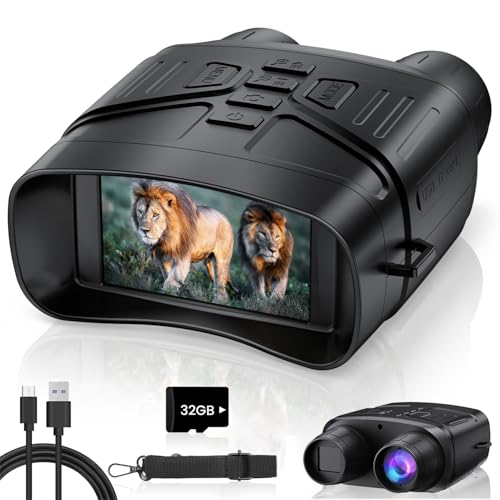
These Vtiisamao night vision binoculars are designed for low-light and complete-darkness use, with an 850nm infrared illuminator and a 3-inch HD screen. A 5000mAh rechargeable battery, 5x digital zoom, and included 32GB memory card make them practical for wildlife observation, camping, hunting, and property monitoring.
Best For: Outdoor users who want rechargeable digital night vision with a large viewing screen and recording.
Pros:
Supports daylight, low-light, and complete-darkness viewing with infrared illumination.
Large 3-inch HD screen allows viewing without placing the device directly against the eyes.
Includes a 5000mAh rechargeable battery and USB-C charging cable.
Captures photos and videos, with a 32GB memory card included.
Cons:
The 25mm objective lens and 5x digital zoom offer less magnification than the other listed models.
A tripod is not included, despite the standard tripod mount.
Runtime varies with infrared level, screen brightness, recording, and other settings.
The NV4000B emphasizes convenient monitoring rather than maximum optical reach. Its screen, rechargeable battery, water-resistant design, and included storage make it well suited to repeated nighttime outdoor use.
We focused on the features that matter most when available light is limited: objective-lens size, optical clarity, magnification, field of view, focusing controls, weather resistance, portability, and intended use. Conventional models are best for natural-looking dusk views, while digital night-vision binoculars use electronic sensors and displays to extend viewing after dark.
We also considered whether each model suits handheld observation. Very high magnification can reveal more detail, but it narrows the field of view and magnifies hand movement. Product descriptions and specifications should be checked carefully before purchase, especially for bundled phone adapters, batteries, and night-vision claims.
Quick Comparison
Best all-around format: 10×42 binoculars offer a useful balance of reach, brightness, size, and handheld stability.
Best for brighter dusk views: 10×50 models collect more light than compact 10×42 designs but are typically heavier.
Best for long-distance detail: 15×52, 18×56, and 20×50 or 20×56 models provide more magnification, ideally with a tripod.
Best for true darkness: Digital night-vision binoculars can work beyond ordinary twilight, but they require power and produce an electronic image.
Best for wet conditions: Waterproof models are better suited to boating, rain, hunting, and camping.
Key Buying Factors for Binoculars for Low Light
Objective Lens and Exit Pupil
The objective lenses are the front lenses. Larger lenses generally admit more light, while the exit pupil indicates how much light reaches your eyes. As a rough guide, 10×42 binoculars have a 4.2 mm exit pupil, while 10×50 models have 5 mm. Larger exit pupils can be helpful at dusk, although brightness also depends on lens quality, coatings, and your eyes.
Magnification and Stability
Higher magnification is not automatically better. At 15x or 20x, small movements become more noticeable, and the narrower view can make moving wildlife difficult to track. A tripod or monopod is often worthwhile for high-powered binoculars.
Optical Quality and Field of View
Look for fully multi-coated optics, a sharp center image, manageable edge softness, and a field of view suited to the subject. Wide views help with birds and wildlife, while long-distance observation may justify a narrower view.
Weather Protection, Focus, and Comfort
Waterproofing and fog resistance matter outdoors. Check the focus wheel, diopter adjustment, eye relief, eyecup design, and weight. Eyeglass wearers should pay particular attention to stated eye relief.
Conventional or Digital Night Vision?
Conventional binoculars usually provide a more natural image and work best in daylight, overcast conditions, and twilight. Digital night vision is more suitable for very dark scenes, but it may show a screen-based image, need infrared illumination, and depend on battery life. Confirm whether infrared use is allowed and appropriate for your setting.
Who Should Buy Which Binoculars for Low Light?
Birders and wildlife watchers: Choose a balanced 10×42 model for portability and a manageable field of view.
Serious dusk observers: Consider 10×50 binoculars when extra light gathering is worth the added size.
Hunters and long-distance viewers: High-powered 15x to 20x models can reveal detail, but plan for support and careful focusing.
Travelers and campers: Prioritize waterproof construction, moderate weight, and simple controls over extreme magnification.
After-dark users: Select digital night-vision binoculars when ordinary optics are not enough, and compare display quality, infrared range, recording features, and battery life.
For most buyers, a waterproof 10×42 model is the safest starting point. Move to 10×50 when dusk brightness matters more than portability, or choose digital night vision when you need visibility in genuinely dark conditions.