The best compact spotting scopes make it easier to identify distant birds, check targets, and observe wildlife without carrying a full-size optical system. The right model balances magnification, image quality, portability, and stability.
Our roundup includes compact scopes in several formats, from lightweight mini spotters to larger angled models with higher-power viewing. Use the guide below to narrow your choice by intended use, optical needs, and budget.
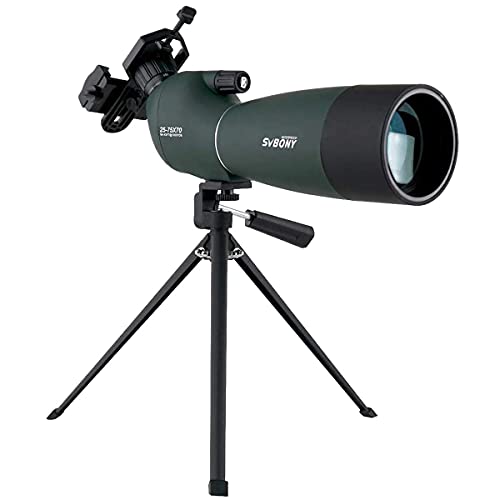
For shoppers comparing compact spotting scopes on a budget, the SVBONY SV28 combines a broad 25-75x zoom range with a large 70mm objective lens. It is a practical starter setup for range sessions, birding, scenery, and family camping, especially since it includes a phone adapter and desktop tripod.
Best For: Beginners who want a portable, ready-to-use scope for target shooting, casual wildlife viewing, and digiscoping.
Pros:
25-75x zoom offers flexible magnification and manual focusing.
Includes a phone adapter, portable tripod, carrying case, and lens covers.
Waterproof, non-slip finish and built-in sunshade support outdoor use.
Cons:
At 910g and 38cm in optical tube length, it is portable but not especially tiny.
The included desktop tripod is geared more toward range spotting than full-height field use.
The 60-day warranty is shorter than the lifetime coverage offered by some alternatives.
The SV28 is a sensible entry-level choice when convenience and included accessories matter more than minimizing size. Its zoom range and phone adapter make it versatile, while the larger objective lens helps in changing outdoor light.
The straight Crossfire HD is a streamlined option among compact spotting scopes, with a 12-36x magnification range and 50mm objective lens. Its HD optical system, helical focus, and Arca-Swiss-compatible foot make it well suited to quick tripod setup and target acquisition.
Best For: Shooters and outdoor observers who prefer a straight viewing layout and want durable, weather-resistant construction.
Pros:
HD optics and fully multi-coated lenses support resolution, color fidelity, and light transmission.
12-36x zoom and wide field of view help with locating and inspecting targets.
Helical focus enables fast, fine adjustments.
Nitrogen purging, waterproof and fogproof construction, and rubber armor add outdoor durability.
Cons:
The 50mm objective lens gathers less light than larger-aperture models.
The straight design may be less comfortable than an angled scope for some tripod positions.
A tripod is not listed among the included accessories.
Choose this model if straightforward alignment and a compact 50mm format are priorities. Vortex adds useful refinements for field use, along with an unlimited, unconditional lifetime VIP warranty.
The Celestron C90 stands out among compact spotting scopes by using a Maksutov-Cassegrain design to fold the light path into a shorter body. With a 90mm objective and 1250mm focal length, it is built for bright, sharp views of distant land targets, astronomy, and camera-assisted observation.
Best For: Long-range observers and digiscoping users who want high magnification potential in a compact optical design.
Pros:
90mm Maksutov-Cassegrain system delivers a long focal length in a compact format.
Designed for birding, target shooting, nature observation, astronomy, and digiscoping.
Includes a 32mm eyepiece, 45-degree erect-image diagonal, finderscope, and backpack.
Accepts optional camera adapters for telephoto-style photography.
Cons:
At 2.1kg, it is heavier than the other scopes in this roundup.
Camera T-adapter and T-ring are optional rather than included.
Manual focusing and a listed equatorial mount may require more setup than a simple range scope.
The C90 is the specialist choice here: compact relative to its focal length, but not lightweight. It makes the most sense for users who value long-range detail, accessory flexibility, and digiscoping potential over quick grab-and-go portability.
The angled Crossfire HD offers the same useful 12-36x range and 50mm objective as its straight counterpart, but its angled eyepiece can make tripod viewing more adaptable. For compact spotting scopes shoppers, it pairs HD optics and weather protection with a relatively manageable 1.9-pound weight.
Best For: Birders, range users, and general outdoor observers who want an angled scope with quick focusing and dependable weather resistance.
Pros:
Angled configuration can provide comfortable viewing from varied tripod heights.
HD optical system and fully multi-coated lenses support clarity and color fidelity.
Helical focus, adjustable eyecup, and wide field of view aid practical field use.
Waterproof, fogproof, shockproof construction is backed by a transferable lifetime VIP warranty.
Cons:
The 50mm objective is less light-gathering than the 65mm and 80mm Crossfire HD models.
A tripod is not listed as included.
The angled eyepiece may be less intuitive for users accustomed to straight scopes.
This is a well-rounded pick when an angled viewing position is more important than maximum aperture. It keeps the useful Crossfire HD features in a compact package and adds strong long-term warranty support.
The Celestron C70 Mini Mak is a particularly portable choice among compact spotting scopes. Its 70mm aperture, 25-75x built-in zoom, and 700mm focal length suit birding, wildlife observation, target shooting, and digiscoping, while the included tabletop tripod makes it ready for convenient use.
Best For: Travelers, birders, and observers who want one compact scope for daytime viewing and occasional astronomical use.
Includes a tabletop tripod with slow-motion controls and a soft case.
Can show astronomical targets such as the Moon, Jupiter, and Saturn.
Cons:
Manual focus requires hands-on adjustment.
The included tabletop tripod is intended for compact, low-profile setups rather than full-size tripod use.
The C70 stands out when storage space and portability matter most. It offers useful magnification and versatile viewing in a small package, though users seeking a larger weather-sealed field scope may prefer a different design.
The Vortex Crossfire HD 20-60×80 offers a larger objective and weather-ready construction for users who want stronger low-light capability in a relatively manageable spotting scope. Its HD optical system, helical focus, and Arca-Swiss-compatible foot make it practical for range, wildlife, and outdoor observation.
Best For: Hunters, range users, and birders who prioritize durability, weather resistance, and a broad 20-60x zoom range.
Pros:
HD optics and fully multi-coated lenses are designed for resolution, color fidelity, and light transmission.
Nitrogen purging provides waterproof and fogproof performance.
Helical focus enables fast and fine adjustments.
Includes an Arca-Swiss-compatible foot, protective covers, and a neoprene cover.
Cons:
At 3.3 pounds and 15.6 inches long, it is less compact than smaller travel scopes.
The 80mm model is better suited to tripod-based setups than casual handheld viewing.
The Crossfire HD is a strong middle ground for buyers who want capable optics and rugged protection without stepping into a more specialized premium scope. Its size and weight are the tradeoffs for the larger objective and outdoor-ready build.
The Athlon Optics Argos HD combines a wide 85mm objective with 20-60x magnification, making it a compelling choice among compact spotting scopes for long-range viewing and lower-light conditions. Its 45-degree angled eyepiece and rotating tripod ring also support comfortable positioning during extended sessions.
Best For: Hunters, birders, and target shooters who want a large objective, angled viewing, and weather-resistant construction.
Pros:
85mm objective and 20-60x zoom support detailed long-range viewing.
HD glass and fully multi-coated lenses are designed for bright, color-accurate images.
Waterproof, fogproof, and argon-purged construction suits changing weather.
Includes a rotating tripod ring, soft case, lens caps, and cleaning cloth.
Cons:
At 16.9 inches and 4.3 pounds, it is the least portable option in this group.
Its large objective and included soft case make it better suited to tripod-supported observation than lightweight travel.
The Argos HD favors viewing brightness and comfort over minimal size. Choose it when the 85mm objective and angled configuration are more important than carrying weight, especially for stationary wildlife or range sessions.
For shoppers comparing compact spotting scopes, the ESSLNB combines a large 70mm objective with a carry-friendly 650g design. Its 20-60x zoom, angled eyepiece, weather-resistant construction, tripod, and phone adapter make it a versatile option for outdoor viewing.
Best For: Bird watching, wildlife viewing, target shooting, hiking, camping, and travel.
Pros:
70mm fully multi-coated objective and BAK4 prism are designed for bright, clear views.
20-60x zoom supports both wide scene scanning and distant detail.
O-ring sealing and nitrogen purging help resist water, fog, dust, and debris.
Includes a tripod, phone adapter, storage bag, and two-year warranty.
Cons:
The larger 70mm objective may be less compact than 50mm alternatives.
The included tripod is intended for convenient setup rather than heavy-duty field use.
Choose this model if you want a feature-rich compact spotting scope with strong weather protection and phone-ready accessories. Its 650g weight keeps it practical for carrying, while the 20-60x range adds flexibility for varied viewing distances.
The Bushnell Prime is a sensible choice among compact spotting scopes for users who prioritize portability and weather resistance. Its 50mm objective, fully multi-coated lenses, roof prism, and included tabletop tripod support practical viewing for hunting, shooting, and sports.
Best For: Hunting, target shooting, sports viewing, and portable outdoor observation.
Pros:
Lightweight 16-ounce design is easy to transport.
Fully multi-coated lenses support brightness and clarity.
IPX7 waterproof and fog-proof construction suits changing weather.
Includes a tabletop tripod, EVA foam case, and soft field cover.
Cons:
Its 50mm objective gathers less light than larger-objective models.
The supplied notes list the magnification as 16x maximum despite the 16-48x model name, so buyers should confirm the listing specifications.
This Bushnell stands out for its low weight, protective accessories, and IPX7-rated construction. It is a good fit when easy packing matters more than having the largest objective lens in the group.
The Barska Colorado offers a straightforward, portable setup for shoppers seeking compact spotting scopes with a straight viewing body. Fully coated optics, a 50mm objective, shock-absorbing rubber armor, and a mini tripod make it suited to casual bird watching and target shooting.
Best For: Casual bird watching, target shooting, and tabletop observation at moderate distances.
Pros:
Compact straight-body design measures 9.5 inches long and weighs about 0.4 kg.
15-40x magnification provides useful flexibility for closer viewing.
Rubber armor helps absorb shocks during handling.
Includes a tabletop tripod and soft carrying case.
Cons:
The supplied notes indicate the clearest range is around 150 yards, with blur naturally increasing beyond that distance.
Fully coated optics are a simpler specification than fully multi-coated systems.
The mini tripod is intended for tabletop use.
This is a practical budget-style option for nearby subjects and easy tabletop setup. Consider it when low weight and included accessories are more important than long-range clarity or advanced optical coatings.
We focused on the features that matter most in a portable spotter: useful magnification ranges, objective-lens size, optical design, viewing comfort, weather resistance, included accessories, and overall portability. The selection covers straight and angled bodies, compact Maksutov designs, range-oriented models, and scopes suited to birding or wildlife observation.
Because higher magnification can expose tripod shake and atmospheric distortion, we considered practical usability rather than maximum power alone. A scope is more useful when it delivers a steady, recognizable image and can be set up quickly in real outdoor conditions.
Quick Comparison
Best For
What to Look For
Models to Consider
Target shooting
Clear detail, stable tripod support, and useful high magnification
SVBONY SV28, Celestron C90, ESSLNB
Birding and wildlife
Comfortable viewing, broad field of view, and manageable weight
Celestron C70, Vortex Crossfire HD 12-36×50 Angled
Maximum reach
Larger objective lens and a sturdy support system
Vortex Crossfire HD 20-60×80, Athlon Argos HD
Easy transport
Short body, low weight, and compact accessories
Bushnell Prime, Barska Colorado
Key Buying Factors for Compact Spotting Scopes
Magnification and Objective Size
Variable zoom gives you flexibility, but the highest setting is not always the clearest. Objective lenses around 50mm are easier to carry, while 70mm to 85mm lenses can provide a brighter image in dim conditions at the cost of extra size and weight.
Straight or Angled Viewing
Straight scopes are quick to aim and work well for lower shooting positions or window-mounted observation. Angled scopes are generally more comfortable for extended viewing, especially when sharing a tripod with people of different heights.
Optics, Focus, and Low-Light Performance
Look for fully coated or higher-grade optical systems, smooth focusing, and adequate eye relief. In practical use, haze, glare, and atmospheric conditions can limit detail before the scope reaches its advertised maximum magnification.
Tripod Stability and Portability
A compact scope still needs a stable tripod. Check whether the included tripod is suitable for the scope’s weight and magnification, and confirm that the mounting system uses a standard connection if you plan to upgrade.
Weather Protection and Accessories
Waterproof or fogproof construction is valuable for birding, hunting, and changing weather. A phone adapter can help with basic digiscoping, but compatibility and stability vary, so treat it as a convenience rather than a substitute for a dedicated camera setup.
Who Should Buy Which Compact Spotting Scopes?
Choose a Small 50mm Scope for Travel and Casual Viewing
Models with 50mm-class objectives are a sensible choice when weight, storage, and quick setup matter most. They suit casual birding, range visits, and general observation in good daylight.
Choose an Angled 70mm to 85mm Scope for Extended Outdoor Use
A larger angled model is better for wildlife watchers and users who spend longer periods behind the eyepiece. It can provide a brighter view and more comfortable positioning, but requires a stronger tripod and more room in a pack.
Choose a Maksutov Design for Detail and Compact Reach
Maksutov scopes can offer substantial focal length in a relatively short body, making them attractive for target shooting and distant viewing. They may be less forgiving of poor stability, so use a solid tripod and realistic expectations in low light.