Building a useful home gym does not require a dedicated room. The best pull-up bars for small spaces deliver effective upper-body training while fitting into a doorway, corner, or compact workout area.
This roundup compares 10 options across doorway bars, free-standing power towers, foldable stations, and multi-function designs. Use the buying guide below to match your available space, preferred exercises, and weight requirements with the right style.
Best 10 Pull Up Bars for Small Spaces Picks for 2026
Best Family Power Tower
RELIFE Adjustable Pull-Up Station

- 400-pound stated capacity with reinforced steel tubing
- Nine height settings for different users
- Pull-ups, dips, rows, knee raises, and push-ups
Best For: Families needing a versatile freestanding home gym station
Best Compact Beginner Station

- Approximate 9.4-square-foot footprint
- Six adjustable height levels
- Rubber feet and reinforced pipe connections
Best For: Beginners seeking a movable freestanding station
Best No-Drill Doorway Bar
Sportneer Adjustable Pull-Up Bar

- Fits 29.5- to 37-inch door frames
- No-drill design with dual-gear locking
- Long integrated handlebar with adjustable width
Best For: Small rooms with a compatible solid wood doorway
Best Foldable Power Tower
YYJO Space-Saving Pull-Up Station

- Folds to a 6.3-inch listed depth
- Eleven height adjustment levels
- 350-pound capacity with multiple exercise options
Best For: Users who need to store a freestanding tower after workouts
Best for Easy Setup
Compact Adjustable Pull-Up Station

- Folds to 37.4" × 13.2" for storage
- 12 height levels from 58.3" to 76.8"
- Supports up to 700 pounds static weight
Best For: Compact home gyms needing a freestanding, foldable station
Best Doorway Pull-Up Bar

- Fits compatible 24"–32" doorways
- Supports up to 440 pounds
- Removable, no-screw installation
Best For: Users needing a portable trainer with minimal floor-space demands
Best Full-Body Power Tower
Adjustable Dip and Pull-Up Station

- 11 height levels up to 84.9"
- Supports pull-ups, dips, push-ups, and knee raises
- Stable H-shaped base with backrest and bands
Best For: Home gyms with room for a versatile full-body station
Best Folding Value
Adjustable Foldable Pull-Up Bar

- Folds for corner or under-bed storage
- Eight height levels up to 84.25 inches
- Supports up to 350 pounds
Best For: Small apartments needing a foldaway freestanding station
Family-Friendly Pick
SogesPower Adjustable Power Tower

- Ten height levels from 65 to 82.7 inches
- Supports pull-ups, dips, knee raises, and push-ups
- 330-pound capacity with suction-cup base
Best For: Families sharing one adjustable multi-exercise station
Best Heavy-Duty Foldaway
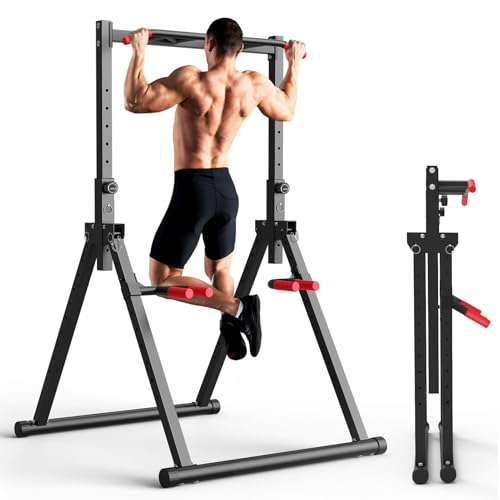
- Folds flat with a triangular frame
- Supports up to 440 pounds
- Five grips plus adjustable dip and push-up handles
Best For: High-capacity training in a foldable home-gym station
Best Family Power Tower – RELIFE Adjustable Pull-Up Station
For shoppers comparing pull up bars for small spaces, the RELIFE power tower offers a compact freestanding setup with adjustable height and several bodyweight exercise options. Its steel frame, suction cups, safety locknut, and integrated push-up bars are designed to keep the station steady during home workouts.
Best For: Families and home gym users who want an adjustable, multifunction tower for pull-ups, dips, rows, knee raises, and push-ups.
Pros:
- Supports up to 400 pounds and uses reinforced steel tubing.
- Nine height settings include a lower position suitable for children.
- Safety locknut, four suction cups, and integrated push-up bars add stability.
- Adjustable armrests and multiple exercise stations expand workout options.
Cons:
- It has a freestanding footprint rather than a wall-mounted design.
- The tower has no backrest.
- Assembly requires all screws to be tightened carefully for stability.
With its broad exercise selection and family-friendly height range, this RELIFE tower is a practical choice when you need one freestanding station for a small home workout area.
Best Compact Beginner Station – Z ZHICHI Pull-Up Dip Station
The Z ZHICHI pull-up and dip station is worth considering among pull up bars for small spaces because its listed footprint is about 9.4 square feet and its 33-pound weight makes it relatively easy for one adult to move. The carbon-steel frame includes rubber feet, adjustable height, and a reinforced pipe connection intended to reduce shaking.
Best For: Beginners who want a movable freestanding station for pull-ups, chin-ups, dips, push-ups, knee lifts, and leg exercises.
Pros:
- Compact base measures approximately 40.9 by 30.1 inches.
- Six height levels accommodate different workout setups.
- Rubber feet help protect wood and other floors from marks.
- Assembly is described as taking less than 20 minutes.
Cons:
- The notes list both a 350-pound capacity and a 330-pound maximum recommendation; verify the applicable limit.
- Users over 6 feet 3 inches or wider than 19.5 inches may need a larger station.
- No warranty is listed in the supplied details.
The compact dimensions and movable design make this a sensible entry-level option, provided its size suits you and you follow the assembly and load guidance.
Best No-Drill Doorway Bar – Sportneer Adjustable Pull-Up Bar
For especially tight living spaces, the Sportneer doorway bar avoids the floor footprint of a power tower. It adjusts from 29.5 to 37 inches and uses PVC friction mats, four metal fixed points, and a dual-gear locking system, but it must be installed on a suitable solid wood door frame.
Best For: Apartment and room users who need a removable, no-drill pull-up bar for a compatible solid wood doorway.
Pros:
- Adjustable width fits door frames from 29.5 to 37 inches.
- No-drill installation leaves no stated drilled holes or traces.
- Integrated handlebar supports flexible grip positions.
- Includes setup guidance, arrow markers, and spirit levels.
Cons:
- The manual specifies a maximum load of 297 pounds, despite higher testing and marketing figures.
- It is designed for solid wood door frames and is not suitable for glass, ceramic tile, or non-solid surfaces.
- Strong adhesion may peel paint on painted or plastered walls.
This is the most space-efficient choice in the group, but doorway compatibility matters more than the headline capacity. Measure carefully and follow the manual’s 297-pound limit.
Best Foldable Power Tower – YYJO Space-Saving Pull-Up Station
The YYJO foldable station stands out among pull up bars for small spaces because its triangular frame can be folded for storage after training. It offers 11 height settings, a 24-inch interior exercise width, assistance bands, and several stations for upper- and lower-body movements.
Best For: Home gym users who want a freestanding tower that can be folded and stored between workouts.
Pros:
- Folded dimensions are listed as 33.46 by 6.3 by 75.2 inches.
- Eleven height settings range from 68.9 to 82.68 inches.
- Triangular steel design is intended to improve stability and prevent rollovers.
- Supports pull-ups, dips, leg raises, abdominal work, and other exercises.
Cons:
- Its listed operating dimensions include a 51.2-inch width, so storage savings do not eliminate setup space.
- The maximum recommended load is 350 pounds.
- Minimal assembly is required, and the supplied details do not specify the assistance-band resistance.
If you need a versatile tower but cannot leave it permanently assembled, the YYJO’s foldable triangular design is a useful compromise between workout variety and storage convenience.
Best for Easy Setup – Compact Adjustable Pull-Up Station
For shoppers comparing pull up bars for small spaces, this foldable power tower offers a useful balance of stability, adjustability, and storage convenience. It supports pull-ups, chin-ups, leg raises, and hanging stretches, while folding from its 37.4″ × 44.9″ workout footprint to 37.4″ × 13.2″ for storage.
Best For: Teens and adults up to 5’5″ who want a freestanding, multi-exercise station that can be folded away in an apartment or compact home gym.
Pros:
- Adjusts across 12 height levels from 58.3″ to 76.8″.
- Triangular anti-tipping base and four adjustable non-slip foot pads help limit wobble.
- Folds compactly for corner or under-bed storage.
- Thickened steel construction is rated for up to 700 pounds of static weight.
Cons:
- The stated height range is best suited to users up to 5’5″.
- A freestanding station requires more floor space during workouts than a doorway bar.
This is a practical choice when storage is a priority but you still want more than basic pull-ups. Its height range and foldable design make it especially suitable for smaller households and shared spaces.
Best Doorway Pull-Up Bar – Heavy-Duty Multi-Grip Trainer
When floor space is limited, a doorway bar can be a simple solution among pull up bars for small spaces. This model mounts without screws in standard 24″ to 32″ doorways and supports pull-ups, chin-ups, push-ups, dips, and hanging crunches, making it easy to store and remove between workouts.
Best For: Home or office users who want a portable upper-body trainer for compatible standard doorways without permanently drilling into the frame.
Pros:
- Supports up to 440 pounds with 1.7mm thickened steel construction.
- Fits standard doorways 24″ to 32″ wide with compatible depth and trim dimensions.
- Multiple grips and exercise positions support pull-ups, dips, push-ups, and hanging crunches.
- Double silicone protection helps reduce marks on the door frame.
Cons:
- Compatibility depends on the doorway’s width, depth, trim height, and trim thickness.
- Requires a firm downward tug test before each use to confirm secure installation.
- Doorway leverage mounting may not suit users seeking a freestanding station.
This is the most space-conscious option of the three because it uses an existing doorway and can be removed for storage. Carefully measure the frame before buying and follow the installation and safety checks.
Best Full-Body Power Tower – Adjustable Dip and Pull-Up Station
This power tower is a strong option for shoppers who want pull up bars for small spaces with broader full-body functionality. Its adjustable design supports pull-ups, chin-ups, dips, push-ups, and vertical knee raises, while the 41.73″ extended H-shaped base is designed to improve stability during training.
Best For: Families or home-gym users who have room for a full-size station and want pull-up, dip, core, and push-up exercises in one unit.
Pros:
- Offers 11 height levels from 71.4″ to 84.9″.
- Combines pull-ups, dips, push-ups, vertical knee raises, and more.
- Extended H-shaped base, enlarged foot pads, and safety locknuts support stability.
- Includes a seven-position backrest and bonus resistance bands.
Cons:
- Its 41.49″ × 43.5″ footprint is less space-efficient than a doorway bar or foldable station.
- Assembly is estimated at 30–60 minutes, and two people are recommended.
- The supplied notes list both a 450-pound feature claim and a 440-pound maximum recommendation; verify the product labeling before use.
This station makes sense when exercise variety matters more than the smallest possible footprint. Its larger base and higher maximum height provide a more substantial setup, but measure your available area and ceiling clearance first.
Best Folding Value – Adjustable Foldable Pull-Up Bar
For shoppers comparing pull up bars for small spaces, this freestanding station stands out for its folding frame and corner- or under-bed storage. Its eight height settings reach 84.25 inches, while the triangular alloy-steel base is rated for up to 350 pounds.
Best For: Small-apartment users who want adjustable pull-ups, chin-ups, dips, and leg raises with foldaway storage.
Pros:
- Folds for storage in a corner or under a bed.
- Eight height levels provide up to 84.25 inches of clearance.
- Triangular base and thickened alloy steel support up to 350 pounds.
- Foam grips, rounded edges, and tool-free height adjustment improve usability.
Cons:
- As a freestanding station, it still requires floor space while in use.
- Assembly is required before the first workout.
This is a practical choice when storage flexibility matters as much as workout variety. The folding design addresses a common small-space limitation without giving up a high stated weight capacity.
Family-Friendly Pick – SogesPower Adjustable Power Tower
This SogesPower power tower is worth considering among pull up bars for small spaces if you want one station for several users. Its height adjusts from 65 to 82.7 inches, and the H-shaped base uses enlarged suction cups for added stability on a flat concrete floor.
Best For: Families seeking adjustable pull-ups, dips, knee raises, push-ups, and leg-pressing exercises in one home station.
Pros:
- Ten height levels accommodate adults and a lower setting for children.
- Supports up to 330 pounds.
- Six exercise positions cover a broad range of upper-body and core movements.
- Long H-shaped base and larger suction cups are designed for stability.
Cons:
- The 32.3-by-29.5-inch base is not foldable and needs a dedicated footprint.
- The manufacturer recommends using it on flat concrete rather than carpet.
- Assembly is required.
Its broad exercise selection and low adjustment range make this a versatile household option. However, buyers prioritizing easy storage should account for the fixed H-shaped base and floor-surface recommendation.
Best Heavy-Duty Foldaway – SERTT Foldable Power Tower
For pull up bars for small spaces that also need broad exercise capability, the SERTT combines a triangular frame with a fold-flat design. It offers ten pull-up heights, adjustable dip and push-up handles, five grip positions, and a stated 440-pound capacity.
Best For: Higher-capacity home gyms needing a foldable station for pull-ups, dips, push-ups, knee raises, and calisthenics.
Pros:
- Triangular design folds flat in seconds for easier storage.
- Supports up to 440 pounds with 2mm thickened steel tubing.
- Five pull-up grips and adjustable dip/push-up handle positions offer exercise variety.
- Includes a 24-month replacement warranty and 120-day money-back guarantee.
Cons:
- Its 39.4-inch width may require more active floor space than narrower stations.
- Assembly is still required, despite the included tools and instructions.
- The supplied notes do not specify the pull-up height range.
This is the strongest fit for users who want storage-conscious equipment without compromising on capacity or exercise options. Its wider frame may be less suitable for extremely tight floors, but it provides more room for unrestricted movement.
How We Picked the Best Pull Up Bars for Small Spaces
We evaluated these pull-up bars by focusing on the factors that matter most in compact home gyms: footprint, storage convenience, construction, adjustment range, stated weight capacity, grip variety, and exercise versatility. We also considered whether each design requires drilling, how easily it can be moved or folded, and whether it supports exercises beyond standard pull-ups.
Because installation and stability vary by product type, always follow the manufacturer’s instructions and verify that your doorway, floor, ceiling height, and surrounding clearance are suitable before use.
Quick Comparison
| Style | Best For | Main Advantage | Potential Trade-Off |
|---|---|---|---|
| Doorway bar | Minimal floor space | Fast setup and easy storage | Limited exercise variety and doorway compatibility |
| Foldable power tower | Compact full-body training | Pull-ups, dips, leg raises, and push-ups | Requires floor space when assembled |
| Adjustable power tower | Multiple users or exercises | Customizable height and positioning | More assembly and a larger footprint |
| Fixed free-standing tower | Frequent home workouts | Dedicated, versatile station | Usually harder to store |
Key Buying Factors for Pull Up Bars for Small Spaces
Measure the Available Space
Measure doorway width, ceiling height, floor depth, and the clearance around the bar. A doorway model may fit a narrow area, while a power tower needs enough room for safe mounting, dips, leg raises, and entry from multiple sides.
Choose the Right Installation Style
No-drill doorway bars are convenient for renters and quick workouts, but they depend on a compatible, structurally sound frame. Free-standing towers avoid wall installation and can offer more exercises, though they take up more floor space.
Check Capacity and Stability
Compare the stated weight limit with your body weight and any planned additional resistance. Look for a sturdy steel frame, wide or weighted base, secure adjustment points, non-slip feet, and minimal rocking. A higher advertised capacity does not replace careful setup.
Consider Grip and Exercise Options
Multi-grip handles can support wide, narrow, neutral, and chin-up positions. If you want more than pull-ups, prioritize stations with dip bars, push-up handles, leg-raise supports, or included assistance bands.
Think About Storage and Adjustment
Folding or height-adjustable models are especially useful when the equipment must share space with furniture. Confirm the folded dimensions and whether one person can safely move or reconfigure the station.
Who Should Buy Which Pull Up Bars for Small Spaces?
Choose a doorway bar if you have very limited floor space, want quick upper-body sessions, and have a compatible frame. These are typically the easiest to store.
Choose a foldable power tower if you want pull-ups, dips, push-ups, and leg raises but need to reclaim floor space after training. Verify the folded size before buying.
Choose an adjustable tower if multiple people will use it or you want to change the bar height for different movements. This style offers flexibility but usually needs more setup space.
Choose a fixed free-standing station if the equipment will remain assembled and you want a more complete home-gym centerpiece. It is best suited to users with a dedicated corner and consistent training routine.
Related Posts:

