Outdoor table tennis practice is easier to maintain when a robot can deliver repeatable shots without requiring a training partner. The best machines help you work on consistency, footwork, timing, spin response, and endurance at your own pace.
This roundup compares 10 table tennis robots, from simple beginner ball launchers to app-controlled models with programmable drills. Because outdoor use adds exposure to dust, moisture, wind, and uneven setups, the right choice depends on more than speed and ball capacity.
Best 10 Table Tennis Robots for Outdoor Practice Picks for 2026
Most Spin Variety

- Creates 36 spinning-ball patterns
- Supports topspin, backspin, sidespin, and combinations
- Requires 40mm balls; holds about 110
Best For: Spin-focused solo training
Best Adjustable Pace

- Serves 12 to 70 balls per minute
- Offers topspin and underspin settings
- Holds up to 110 balls
Best For: Adjustable-speed solo drills
Simple Solo Training Pick

- Supports practice without a partner
- Adjusts spin and speed
- Includes 100 training balls
Best For: Basic adult solo practice
Best Portable Battery Option

- Runs wirelessly on four AA batteries
- Launches up to 30 balls per minute
- Includes 20 standard 40mm ABS balls
Best For: Portable beginner practice
Best Programmable Pick

- 576 pre-saved trajectories
- Remote and app control
- Adjustable speed, spin, landing, and height
Best For: Adults seeking highly customizable solo drills
Best Simple Setup

- Up to 70 balls per minute
- Wireless remote control
- No app or complicated assembly
Best For: Beginners and families wanting easy solo practice
Best Ball-Recycling System
WAYMARK JT-A Table Tennis Robot

- Net holds up to 200 balls
- 8.9–76 mph speed range
- Nine customizable spin modes
Best For: Players wanting efficient, extended solo drills
Lightweight Starter
Vbestlife Automatic Table Tennis Trainer

- Lightweight 664-gram portable design
- Simple one-switch automatic feeding
- Includes 10 practice balls
Best For: Beginners practicing basic returns and reactions
Adjustable Outdoor-Ready Pick
WAYMARK HP-07 Table Tennis Robot
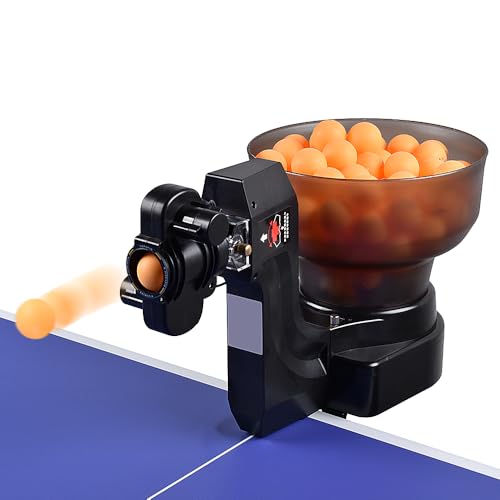
- Nine spin modes with dual motors
- 120-ball hopper for longer sessions
- Clamp fits tables up to 2.5 inches thick
Best For: Players wanting varied spin, speed, and placement drills
Connected Drill System
PONGBOT Robot with Net and App Control

- Includes a ball recycling net
- 264 pre-saved drills plus custom drills
- Remote and smartphone-app control
Best For: Players seeking structured and customizable training
Most Spin Variety – 36-Spin Ping Pong Robot
If you want table tennis robots for outdoor practice with varied ball movement, this machine offers 36 spinning-ball patterns and adjustable positioning. Its portable design is practical for players who need a flexible training setup, though you will need to provide enough standard-size balls.
Best For: Players seeking extensive topspin, backspin, sidespin, and combination-spin practice.
Pros:
- Offers 36 different spinning-ball options.
- Supports topspin, backspin, sidespin, and combinations.
- Holds approximately 110 balls and is easy to install.
- Includes a one-year warranty for quality issues during normal use.
Cons:
- 40mm international-standard balls are required and are not included.
- At least 15 balls must be loaded for the machine to serve properly.
- The falling point is not fixed.
This is a strong choice when spin variety matters most. Its portable ABS construction and large hopper support repeat practice, but plan on buying compatible balls separately.
Best Adjustable Pace – iPong Original Trainer Robot
For table tennis robots for outdoor practice, the iPong Original stands out for its adjustable serving frequency and straightforward setup. It can deliver balls at 12 to 70 per minute, making it suitable for slower technique work or faster repetition drills.
Best For: Players who want adjustable training speed and basic topspin or underspin practice.
Pros:
- Adjustable frequency from 12 to 70 balls per minute.
- Provides topspin and underspin settings.
- Holds up to 110 balls for extended sessions.
- Includes a remote control, AC adapter, and instructions.
Cons:
- Uses an AC adapter rather than battery operation.
- Its listed spin options are limited to topspin and underspin.
- Compatible accessories and balls may need to be purchased separately.
The iPong Original is a practical, speed-focused trainer with a generous hopper. It is especially useful when you want to control drill pace without needing a partner.
Simple Solo Training Pick – Suz S101 Ping Pong Machine
The Suz S101 is a straightforward option among table tennis robots for outdoor practice, designed to help players train without a practice partner. Its adjustable spin and speed settings can support repeat drills, and the package includes 100 balls for getting started.
Best For: Adult players who want a basic solo-training machine with included balls.
Pros:
- Designed for solo practice and coaching.
- Adjustable spin and speed help vary drills.
- Includes 100 balls, listed as 101 total items.
- Offers one year of EU spare-part availability.
Cons:
- The supplied details do not specify serving frequency or hopper capacity.
- Spin types and other advanced settings are not detailed.
- Color is listed as orange, white, or random.
This model emphasizes accessible solo practice rather than a long list of documented features. It is worth considering if included balls and adjustable speed and spin are more important than precise performance specifications.
Best Portable Battery Option – JOOLA iPong Play Robot
JOOLA iPong Play Table Tennis Trainer Robot with 20 ABS Training Balls, Orange
Check Price On AmazonThe JOOLA iPong Play is a convenient choice for table tennis robots for outdoor practice because it runs on four AA batteries and requires no outlet. It arrives assembled, includes 20 standard 40mm ABS balls, and can launch up to 30 balls per minute for basic drills and games.
Best For: Beginners and families who want a compact, wireless trainer for portable practice.
Pros:
- Battery-operated and wireless for flexible placement.
- Launches up to 30 balls per minute.
- Arrives fully assembled and is simple to operate.
- Includes 20 quality-tested 40mm ABS training balls.
Cons:
- Four AA batteries are required and are not included.
- The supplied details do not list adjustable spin settings.
- Its 20-ball starting supply is smaller than some larger-hopper models.
With its compact size, wireless operation, and simple controls, the iPong Play is well suited to entry-level practice and portability. Choose another model if advanced spin programming or longer unattended sessions is a priority.
Best Programmable Pick – PONGBOT Table Tennis Robot
For players comparing table tennis robots for outdoor practice, the PONGBOT stands out for its extensive drill customization. Remote and app control, automatic oscillation, and 576 pre-saved trajectories make it suited to structured solo sessions.
Best For: Adults who want programmable drills and a wide variety of preset trajectories.
Pros:
- Includes 576 pre-saved trajectories for varied practice.
- Supports remote and app control.
- Allows adjustment of frequency, ball speed, rotation, landing, and height.
- Automatic oscillation helps vary ball placement.
Cons:
- At 14 kg, it is heavier than the listed iPong model.
- The supplied notes do not specify a built-in ball recycling net.
The PONGBOT is a strong choice when drill variety matters more than minimal weight. Its programmable settings can support progressive practice, provided you have a suitable outdoor setup and access to power.
Best Simple Setup – iPong V300 Training Robot
The iPong V300 is a straightforward option for table tennis robots for outdoor practice, especially if you want solo training without an app. Its wireless remote controls frequency, speed, direction, and spin, while assembly requires simply attaching the ball feeder.
Best For: Beginners, families, and players who want quick setup with remote-controlled practice.
Pros:
- Shoots up to 70 regulation 40 mm balls per minute.
- Frequency can be adjusted from 30 to 70 balls per minute.
- Wireless remote includes a memory button and controls speed, direction, and spin.
- Requires no app download or complicated setup.
Cons:
- Does not include the net-based ball recycling system listed for the WAYMARK model.
- The supplied notes describe it as a table-mounted training robot rather than an outdoor-specific unit.
With its low listed weight of 3.1 pounds and uncomplicated controls, the V300 is convenient to move and operate. It offers useful basic adjustments, though players wanting extensive programmable drills may prefer a more feature-rich robot.
Best Ball-Recycling System – WAYMARK JT-A Table Tennis Robot
For outdoor practice sessions where collecting balls can interrupt your rhythm, the WAYMARK JT-A combines a serve machine with a recycling net. It holds up to 200 balls, includes 100 balls, and offers adjustable speed, angles, landing points, and multiple spin modes.
Best For: Players who want longer solo sessions with automatic ball collection and detailed spin control.
Pros:
- Automatic recycling net holds up to 200 balls.
- Offers speeds from 8.9 to 76 mph for different skill levels.
- Supports topspin, backspin, no-spin, left-spin, right-spin, mixed-spin, and nine spin modes.
- Control panel can be positioned on either side for ambidextrous use.
Cons:
- Fits tables up to 2.5 inches thick, so table compatibility should be checked.
- At 7.5 kg, it is less lightweight than the iPong V300.
- The supplied warranty details are inconsistent, mentioning both two years and one year.
The JT-A is particularly practical for repetitive outdoor drills because its net reduces ball pickup. Its broad speed and spin range also gives it room to serve beginners and advanced players, assuming the table and available space meet its requirements.
Lightweight Starter – Vbestlife Automatic Table Tennis Trainer
If you want table tennis robots for outdoor practice without a complicated setup, the Vbestlife launcher is a compact beginner-focused option. Its automatic ball feeding, one-switch operation, and included 10 balls make it easy to start basic return and reaction drills, although the supplied details list it for indoor use.
Best For: Beginners and children who want a portable, simple solo trainer for basic practice.
Pros:
- Lightweight 664-gram design is easy to carry.
- Automatic feeding supports uninterrupted practice.
- One-switch operation requires minimal setup.
- Wide ball exit is designed to help prevent jamming.
Cons:
- Supplied details specify indoor use rather than outdoor use.
- Includes only 10 balls, limiting longer sessions.
- Does not list adjustable spin, speed, or oscillation settings.
This is a practical entry-level choice for straightforward forehand, backhand, and reaction practice. Buyers seeking advanced drills or outdoor-specific construction should consider a more configurable robot.
Adjustable Outdoor-Ready Pick – WAYMARK HP-07 Table Tennis Robot
For shoppers comparing table tennis robots for outdoor practice, the WAYMARK HP-07 stands out for its portable clamp-on setup and broad training controls. Its dual motors provide nine spin modes, adjustable speed and frequency, oscillation, and pitch settings, but the notes do not explicitly rate it for weather exposure.
Best For: Players who want solo drills ranging from beginner intensity to advanced spin and placement practice.
Pros:
- Offers nine spin variations, including topspin, backspin, sidespin, and no-spin.
- Speed range is listed from 8.9 to 76 mph.
- 120-ball hopper supports extended sessions.
- Tool-free clamp fits tables up to 2.5 inches thick.
Cons:
- Ball catch net is sold separately.
- At 3.3 kg, it is less lightweight than basic portable trainers.
- Outdoor weather resistance is not specified.
The HP-07 is the strongest fit here for configurable practice and realistic variation. Its large hopper and wide adjustment range reduce interruptions, while outdoor users should protect it from moisture and confirm their table setup.
Connected Drill System – PONGBOT Robot with Net and App Control
The PONGBOT is a versatile option for table tennis robots for outdoor practice when you value structured training and easy control. It includes a ball recycling net, supports remote and smartphone-app operation, and provides 264 pre-saved drills plus custom-drill creation; however, the supplied information does not specify outdoor weather resistance.
Best For: Players of different skill levels who want guided routines, custom sessions, and convenient controls.
Pros:
- Includes a ball recycling net for simpler setup and collection.
- Offers both remote and smartphone-app control.
- Provides 264 pre-saved drills.
- Allows users to create custom drills.
Cons:
- Outdoor durability or weather resistance is not listed.
- At 4 kg, it is heavier than the Vbestlife trainer.
- Only a one-year warranty is specified.
This model is appealing for players who prefer a large library of programmed exercises rather than basic ball launching. The included net and app control make practice more organized, but outdoor storage and weather protection will require attention.
How We Picked These Table Tennis Robots for Outdoor Practice
We focused on training usefulness, portability, control options, ball handling, and setup practicality. The selection includes compact entry-level robots, models supplied with nets, and advanced machines offering remote or app control and pre-saved drills. For outdoor practice, we also considered how easy each design is to transport, cover, empty, clean, and reposition between sessions.
Outdoor conditions can affect ball flight and electronics, so product specifications should be checked carefully before purchase. A robot described as portable or suitable for solo practice is not automatically weatherproof. Use these machines on a dry, stable surface and store them indoors after practice unless the manufacturer explicitly states otherwise.
Quick Comparison
| Best for | Look for | Useful features |
|---|---|---|
| Beginners | Simple controls and moderate speed | Easy setup, included balls, compact storage |
| Solo fundamentals | Consistent feed and adjustable placement | Oscillation, frequency control, spin settings |
| Structured training | Multiple drills and trajectory control | Remote or app programming, saved routines |
| Outdoor portability | Low weight and secure mounting | Integrated net, carrying handle, quick assembly |
Key Buying Factors for Outdoor Practice
Ball Capacity and Feed Consistency
A larger hopper means fewer interruptions, while a dependable feed matters more than maximum capacity. Confirm whether the robot requires a particular ball size or material, and use clean, undamaged balls to reduce jams.
Spin, Speed, and Placement Control
Look for adjustable speed, frequency, elevation, and oscillation if you want to progress beyond basic forehand repetition. Spin controls are especially valuable for practicing serves, pushes, blocks, and topspin responses.
Controls and Training Modes
Basic dials are quick to use outdoors, while remote and app controls can make advanced drills easier to repeat. Pre-programmed trajectories are convenient; custom drills are better for targeted skill work.
Portability and Weather Protection
Choose a design you can move without disturbing the table. A supplied net may simplify collection, but it also adds setup considerations. Protect every robot from rain, condensation, direct sun, and dusty storage, and verify power requirements before heading outside.
Who Should Buy Which Table Tennis Robots for Outdoor Practice?
Beginners should prioritize simple operation, gentle speed ranges, and a manageable ball supply. Players building consistency may prefer oscillation and adjustable feed intervals. Intermediate and advanced players should consider models with varied spin, remote or app control, and programmable drills. If outdoor practice locations change frequently, prioritize portability and fast setup over a large feature list.
Related Posts:

