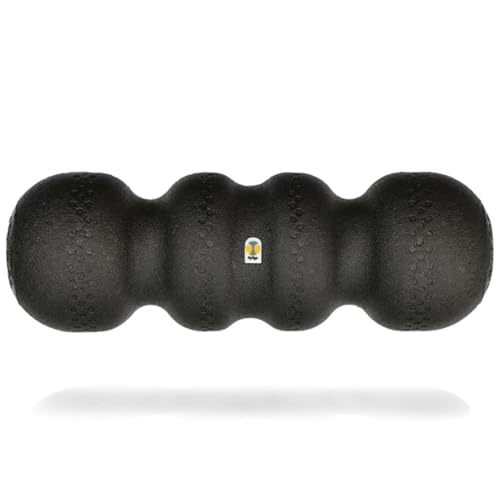
The Rollga PRO foam roller is best for buyers who already know they want firm, focused pressure and a more thoughtful surface than the usual smooth tube.
The listing positions it as a recovery tool for back pain relief, mobility work, warm-ups, and deep tissue massage, and the design choices support that story.
The grooves and cutouts are meant to protect bony areas while still reaching the muscles around them, which makes this product more specialized than a standard foam roller.
That specialization is also its main downside: if you want a gentle, beginner-friendly roller, this is probably too aggressive.
For the right buyer, though, the Rollga PRO foam roller is a strong, purpose-built option.
It fits people who want to manage soreness, open up tight areas, or add a harder roller to an existing recovery routine.
It also makes sense for travel or gym bags because the listing describes it as lightweight and durable.
The biggest decision factor is tolerance for pressure: the PRO version is described as 20% harder than the standard Rollga, so this is a roller for users who prefer a more assertive massage feel.
Review Scorecard
Category
Score
Rationale
Targeted back comfort
9/10
The contoured grooves are designed to avoid direct pressure on the spine and shoulder blades.
Deep tissue pressure
9/10
The PRO version is listed as 20% harder, which supports stronger muscle release.
Recovery versatility
8/10
The listing supports use on the neck, back, legs, arms, and feet.
Portability
8/10
Lightweight construction makes it easy to carry to the gym or while traveling.
Beginner friendliness
5/10
The firmer profile is better for experienced foam rollers than first-timers.
Value for specialization
8/10
The shape and hardness are clearly aimed at buyers who need more than a basic roller.
The Rollga PRO foam roller is an 18-inch roller built around a patented grooved design.
According to the listing, the grooves and bumps are meant to mimic hands-on massage while helping the roller avoid direct pressure on sensitive areas like the spine and shoulder blades.
That gives it a more anatomical shape than a standard smooth foam cylinder.
The manufacturer also describes the PRO model as 20% harder than the standard Rollga.
In practical terms, that means stronger pressure and a firmer feel during rolling.
The tradeoff is simple: it should dig deeper into tight tissue, but it will not feel forgiving.
The listing highlights several use cases:
back pain relief
post-workout soreness recovery
pre-workout warm-up
flexibility and mobility work
yoga and Pilates support
physical therapy routines
It is also presented as versatile across the neck, back, legs, arms, and feet.
That makes it a multi-area recovery tool rather than a single-purpose back gadget.
The portability angle matters too: the product is described as lightweight and durable, so it is meant to be moved around rather than left in one place.
In short, the main specifications and claims are less about flashy extras and more about a focused design philosophy:
18-inch length
patented contoured grooves
bump pattern intended to reach deeper tissue
spine- and shoulder-blade-friendly shape
firmer PRO-density feel
lightweight, portable build
Pros and Cons of Rollga PRO
Pros
The contoured surface is more thoughtful than a plain roller for back work.
The harder PRO version should suit users who want stronger pressure.
The shape is designed to spare the spine and shoulder blades.
It can be used for multiple body areas, not just the back.
The lightweight build supports gym-bag and travel use.
Cons
The firmness may be too much for beginners or very sensitive users.
The specialized shape makes it less universal than a smooth roller.
If you want broad, gentle coverage, a standard roller may be easier to live with.
The product is clearly aimed at targeted pressure, so it is not the best match for users seeking a soft recovery tool.
The most important takeaway is that the strengths and weaknesses come from the same design.
The Rollga PRO is better because it is more aggressive and more anatomically shaped, but that also makes it less approachable.
Buy the Rollga PRO foam roller if you want firmer pressure and have a specific recovery goal.
It is a sensible fit for lifters, runners, yoga practitioners, and anyone who likes deep tissue-style rolling after training or before a workout.
It also looks well suited to people who want to work around the back more carefully instead of pressing a smooth cylinder directly into the spine.
The best buyer is someone who already uses foam rollers and wants more intensity.
The listing’s note that the PRO version is harder than the standard model is a strong clue that this is not the first roller most people should try, but it may be the better one once you know you want more pressure.
Skip it if you are very sensitive to pressure, new to foam rolling, or looking for a universally comfortable roller for the whole household.
In those cases, a softer, simpler design will likely feel easier to use.
Skip it too if your main goal is general relaxation rather than targeted deep tissue work.
How the Rollga PRO Handles Recovery
Contoured Pressure
The Rollga PRO’s grooves are the defining feature.
They are intended to create pressure where muscles need it while reducing direct contact with bony structures.
That matters most for back work, where many rollers are effective in theory but awkward in practice.
Harder Feel
The listing’s claim that the PRO version is 20% harder is not a small detail.
It changes the user experience significantly.
This is the kind of roller that should feel productive when a muscle is tight, but possibly excessive if you want a lighter session.
Multi-Area Use
Because the roller is described for the neck, back, legs, arms, and feet, it has enough range to justify a place in a broader mobility kit.
That versatility helps if you want one tool for warm-ups, cooldowns, and general recovery work.
Portability and Durability
The lightweight, durable design makes the Rollga PRO easier to store and carry than bulkier recovery gear.
That is useful if you move between home, gym, and travel, and it supports the idea that this is a practical tool rather than a specialized accessory that stays on a shelf.