The best push-pull running sleds can turn a short stretch of turf, grass, or pavement into a demanding workout for acceleration, leg drive, and full-body strength. The right model should match your training surface, loading goals, and available storage space.
We compared these 10 sleds by construction, handle design, adjustability, capacity, versatility, and value so you can choose a practical option for athletic training or general conditioning.
Best 10 Push Pull Running Sleds Picks for 2026
Best All-Terrain Pick
Adjustable Heavy-Duty Push Pull Sled

- Five-position handle for varied users and pushing angles
- Fits both 1-inch and 2-inch weight plates
- Curved base supports outdoor training on uneven surfaces
Best For: Outdoor football, speed, and strength training
Best Dual-Use Value

- Adjustable push bar with five height settings
- Designed for both pushing and pulling
- Includes straps, barbell bar, and gloves
Best For: Mixed sports conditioning and sprint workouts
Best for Sprint Training

- 550-pound capacity with dual plate compatibility
- Five adjustable handle positions for varied angles
- Padded reinforced harness included
Best For: Loaded acceleration, football, and CrossFit drills
Best Compact Option
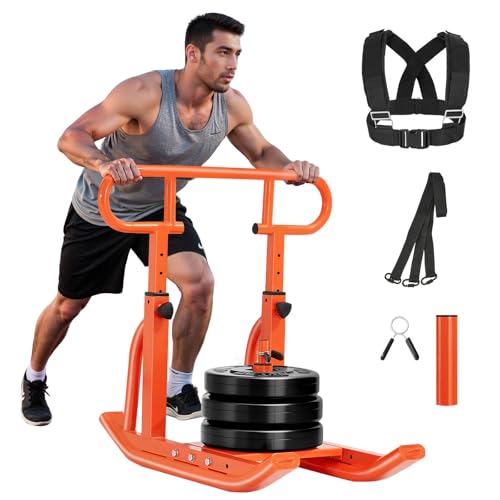
- Five-height all-around handle for varied angles
- Dual sleeves fit 1-inch and 2-inch plates
- Disassembles for transport and storage
Best For: Portable home-gym and moderate-load training
Heavy-Duty All-Surface Pick
Titan Fitness Pro Sled Core Unit

- 750-pound capacity for demanding workouts
- Works on grass, turf, concrete, and asphalt
- Supports multiple optional Titan accessories
Best For: Athletes seeking a configurable, high-capacity training sled
Quick-Change Training Pick
TE DEUM Weight Training Pull Sled

- Dual holders promote balanced plate loading
- Fits standard 2-inch Olympic plates
- Push-pull bar switches sides quickly
Best For: Gym users wanting a simple, balanced Olympic-plate sled
High-Low Handle Pick
Titan Fitness High-Low Push Pull Drag Sled

- High and low handles support varied stances
- 600-pound capacity with dual Olympic sleeves
- 64-pound steel sled for easier portability
Best For: Athletes targeting sprint mechanics and leg power
Best Adjustable-Resistance Pick

- Accepts 1-inch and 2-inch weight plates
- Curved base helps clear uneven obstacles
- Includes adjustable vest and strap
Best For: Variable-surface training with flexible plate compatibility
Best Reversible Training Design
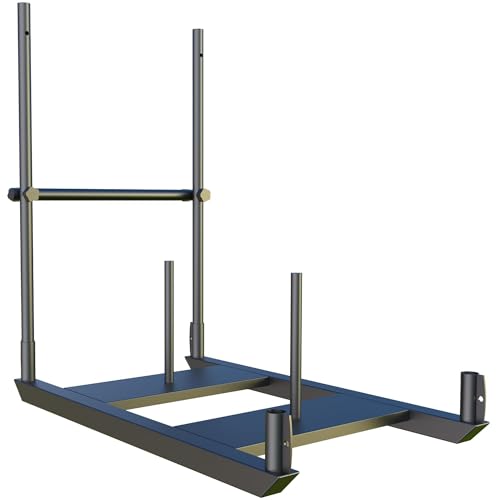
- Quick-release poles support 180-degree reversals
- Horizontal bar enables lower pushing
- Multiple anchors support bands and cables
Best For: Versatile athletic, CrossFit, and rehab-oriented drills
Best Heavy-Duty Capacity

- Accepts Olympic plates up to a 600-pound recommendation
- Converts between pushing and pulling workouts
- Built for indoor and outdoor training surfaces
Best For: High-load athletic training and gym environments
Best All-Terrain Pick – Adjustable Heavy-Duty Push Pull Sled
If you need push pull running sleds for varied outdoor workouts, the GarveeLife model combines a five-position handle with compatibility for both 1-inch and 2-inch weight plates. Its curved base is designed to glide across grass, gravel, and uneven terrain, while the steel construction supports loads up to 550 pounds.
Best For: Athletes and fitness enthusiasts who want adjustable resistance for football drills, speed training, and outdoor strength work.
Pros:
- Five handle heights from 1.6 to 4 feet accommodate different users and pushing positions.
- Accepts both standard 1-inch and Olympic 2-inch weight plates.
- Heavy-duty construction supports up to 550 pounds.
- Curved, wide base is suited to grass, gravel, and uneven surfaces.
Cons:
- No warranty is listed in the supplied details.
- At 27.8 pounds, it may require planning for transport and storage.
The adjustable handle and all-terrain base make this a flexible choice for users who train outdoors and want one sled for both pushing and pulling. Its broad plate compatibility also makes progressive loading straightforward.
Best Dual-Use Value – Five-Level Training Sled
This heavy-duty option is built for push pull running sleds workouts that combine speed, strength, and conditioning. Its five-level adjustable push bar and dual-use design let you switch between pushing and pulling, while the plate posts accept both 1-inch and 2-inch weights.
Best For: Users seeking a versatile sled for soccer drills, sprint work, explosive power, and full-body conditioning.
Pros:
- Five push-bar settings help accommodate different heights and training preferences.
- Supports both pushing and pulling exercises.
- Accepts standard and Olympic weight plates.
- Includes pulling straps, a barbell bar, and gloves.
Cons:
- The listed warranty is only three months.
- The supplied details do not specify a maximum load capacity.
Choose this model if exercise variety matters more than a stated high load rating. The included accessories and adjustable bar make it a practical starting point for mixed athletic conditioning.
Best for Sprint Training – 550-Pound Football Sled
For athletes comparing push pull running sleds for acceleration work, this football sled emphasizes force transfer and adjustable positioning. It accepts 1-inch and 2-inch plates, supports up to 550 pounds, and uses a curved base intended for grass, turf, concrete, rubber tracks, and other training surfaces.
Best For: Sprint, football, CrossFit, soccer, and high-intensity speed training where substantial progressive loading is useful.
Pros:
- Supports up to 550 pounds and fits both common plate sizes.
- Five-level adjustable handles allow varied push and pull angles.
- Curved base is designed for smooth movement across multiple surfaces.
- Includes a widened, padded harness with reinforced stitching.
Cons:
- At 35.5 pounds, it is heavier than some compact sleds.
- The larger dimensions may require more storage space.
The offset base and adjustable handles make this a strong match for users focused on acceleration and demanding conditioning sessions. The included harness also makes pulling work more comfortable during repeated drags.
Best Compact Option – VEVOR Full-Range Weight Sled
The VEVOR weight sled is a practical choice for push pull running sleds training when adjustable angles and easier storage are priorities. It has a five-height all-around handle, four pull hooks, dual plate sleeves, and a compact design that can be disassembled for transport or storage.
Best For: Home-gym users and athletes who want a portable sled for gym floors, artificial turf, tracks, and outdoor workouts.
Pros:
- Five-height handle supports multiple push and pull angles.
- Four pull hooks help stabilize dragging.
- Fits both 1-inch and 2-inch weight plates with locking support.
- Compact, disassemblable design is convenient for storage and transport.
Cons:
- Maximum supported load is 276.6 pounds, lower than some listed alternatives.
- The supplied details do not list a warranty.
This sled stands out when portability and setup convenience are important. Its lower stated capacity makes it better suited to moderate progressive training than to the heaviest loaded drags.
Heavy-Duty All-Surface Pick – Titan Fitness Pro Sled Core Unit
The Titan Fitness Pro Sled Core Unit is a versatile option for athletes comparing push pull running sleds for speed work, agility drills, and strength training. Its 750-pound capacity, push poles, weight sleeve, and compatibility with grass, turf, concrete, and asphalt make it suitable for varied training environments.
Best For: Football players, sprinters, runners, and athletes who want a highly configurable sled for pushing, pulling, dragging, and accessory-based workouts.
Pros:
- 750-pound capacity with durable 11-gauge steel upright skids and a 0.25-inch-thick base plate.
- Designed for use on grass, turf, concrete, and asphalt.
- Supports push, pull, drag, sled rows, pull-throughs, sprints, core work, and battle-rope attachments.
- Compatible with multiple optional Titan accessories, including high bars, low bars, and replacement shoes.
Cons:
- The 102-pound sled is relatively heavy to move and store.
- Several useful accessories and carabiners are not included.
- Its large 24-by-40-inch footprint may require dedicated storage space.
With its high load rating and broad accessory compatibility, this is a strong choice for serious training setups. Factor in the sled’s weight and the added cost of optional attachments when comparing it with simpler push pull running sleds.
Quick-Change Training Pick – TE DEUM Weight Training Pull Sled
The TE DEUM Weight Training Pull Sled is a straightforward choice for shoppers comparing push pull running sleds for strength, speed, and conditioning work. It uses extra-thick steel construction, dual plate holders, and a quick-switch push-pull bar to support directional changes during training.
Best For: Home or commercial gym users who want a steel sled for pushing, pulling, dragging, and Olympic plate-based workouts.
Pros:
- Extra-thick steel frame is designed to handle tough workouts and heavy loads.
- Dual plate holders help distribute weight and reduce wobble or tipping.
- Accepts standard 2-inch Olympic weight plates.
- Push-pull bar can be switched from side to side in seconds.
Cons:
- It is suitable only for 2-inch weight plates.
- The listed warranty is limited to three months.
- The supplied notes do not specify supported training surfaces or a load capacity.
This sled emphasizes stability and convenient direction changes rather than extensive configuration. It is worth considering if your training space already uses Olympic plates and you prefer a simple push-pull setup.
High-Low Handle Pick – Titan Fitness High-Low Push Pull Drag Sled
The Titan Fitness High-Low Push Pull Drag Sled is a practical option among push pull running sleds for athletes who want different pushing stances. Its high and low handles support upright sprint mechanics and lower-position resistance work, while dual Olympic plate sleeves provide up to 600 pounds of loading capacity.
Best For: Athletes training explosive sprint mechanics, leg power, and upper- and lower-body strength on turf, concrete, or other hard surfaces.
Pros:
- High and low handles accommodate different stances and training targets.
- Dual 9-inch Olympic weight sleeves support loads up to 600 pounds.
- Built for use on turf, concrete, and other hard surfaces.
- Steel construction offers a durable yet more portable 64-pound sled body.
Cons:
- Optional plastic ski liners are sold separately.
- The sled-only style does not include additional handle attachments or accessories.
- Its 600-pound capacity is lower than the 750-pound rating of the Titan Pro Sled Core Unit.
The high-low handle design gives this sled a clear advantage for stance-specific training and sprint-focused workouts. Consider the separate cost of plastic skis if you want additional surface protection.
Best Adjustable-Resistance Pick – GDFISH Large Weight Sled
If you want push pull running sleds with flexible loading options, the GDFISH Large Weight Sled accommodates either 1-inch or 2-inch weight plates. Its curved base is designed to clear obstacles across grass, sand, cement, carpet, and other sports surfaces.
Best For: Runners and athletes who want adjustable resistance, an included vest and strap, and a sled suitable for varied training surfaces.
Pros:
- Supports both 1-inch and 2-inch weight plates, with a stated capacity of up to 286 pounds.
- Arc-shaped bottom helps the sled pass over uneven surfaces and obstacles.
- Includes an adjustable vest and strap with self-locking steel buckles.
- Double-screw joint fixation is designed to improve stability.
Cons:
- Weight plates are not listed among the included components.
- Assembly requires installing the long side screws before the short top screws.
- Its 8.33 kg weight may be less substantial than heavier commercial sleds.
The dual-diameter loading system makes this a practical choice when your existing plates vary in size. It is especially appealing for outdoor users who need a relatively adaptable push-and-pull sled.
Best Reversible Training Design – Weight Sled XL
For athletes comparing push pull running sleds, the Weight Sled XL emphasizes quick changes between pushing and pulling. Its horizontal push bar, reversible push poles, multiple anchor points, and reinforced alloy-steel construction support varied drills indoors or outdoors.
Best For: Athletes and gyms seeking a versatile sled for speed work, power pulls, resistance-cable drills, and rehabilitation-oriented low-load exercises.
Pros:
- Two quick-release push poles can lock into four socket anchors for 180-degree reversals.
- Horizontal push bar provides a lower pushing position.
- Anchor points accommodate TRX bands, harnesses, and resistance cables.
- Reinforced 3 mm ASTM F1623-certified tubing legs and a stated three-year warranty support durability.
Cons:
- Weight plates and straps are not included.
- The 18.8 kg package weight and large dimensions may make storage and transport less convenient.
- The supplied notes do not specify a maximum loading capacity.
This model stands out for training variety rather than a simple fixed setup. The reversible poles and multiple anchor points make it a strong option for users who want to alternate pushing, pulling, and band-based movements.
Best Heavy-Duty Capacity – REP Fitness Power Sled
The REP Fitness Power Sled is a heavy-duty option among push pull running sleds, with a steel frame designed for repeated strength and conditioning work. It accepts Olympic plates and supports both upright pushing and pulling through its modular setup.
Best For: Home gyms, football programs, CrossFit facilities, and athletes who need high-load speed, agility, and lower-body power training.
Pros:
- Accepts Olympic weight plates for scalable resistance.
- Supports upright pushing and pulling with vertical posts and an included tow point.
- Rated for a maximum recommended weight of 600 pounds.
- Designed for indoor or outdoor use on turf, rubber flooring, grass, or pavement.
Cons:
- At 68 pounds, it is relatively heavy to move compared with lighter sleds.
- Its Olympic-plate design may be less convenient if you only own standard plates.
- The supplied notes do not mention an included harness or strap.
With its substantial steel construction and high stated load recommendation, this sled is suited to progressive, demanding workouts. Its compact footprint and push-pull configuration also make it practical for dedicated training spaces.
How We Picked the Best Push Pull Running Sleds
We focused on the features that affect real-world sled training: frame durability, handle height and adjustability, push and pull functionality, weight capacity, surface compatibility, and ease of setup. We also considered whether each sled supports different loading formats, including standard weight plates, Olympic plates, or other resistance options.
Because training environments vary, the selection includes compact basic sleds as well as heavier-duty designs intended for frequent use. A sled that works well on grass may not perform equally on turf, concrete, or asphalt, so surface guidance and hardware compatibility are important parts of the comparison.
Quick Comparison
| Feature | What to look for |
|---|---|
| Handle design | Adjustable or multi-position handles provide more push and pull options. |
| Capacity | Choose enough rated capacity for your current training and likely progression. |
| Loading system | Check whether the sled accepts 1-inch plates, 2-inch Olympic plates, or both. |
| Surface use | Confirm whether the frame and feet are intended for grass, turf, concrete, or asphalt. |
| Portability | Consider frame weight, removable handles, and storage requirements. |
Key Buying Factors for Push-Pull Running Sleds
Construction and Capacity
Steel frames are preferred for repeated heavy loading, but a larger capacity is not automatically better. Match the sled to your available plates, training space, and ability to control the load. Overloading can make the sled difficult to move and may accelerate wear on contact points.
Push, Pull, and Drag Versatility
Look for a stable base and handles that support comfortable body positioning. Higher or lower handle settings can change leverage and help accommodate different users. If you plan to use a harness, rope, or strap, verify that the frame includes a suitable attachment point.
Surface and Foot Design
Grass and turf are generally more forgiving than concrete or asphalt. Some sleds are designed for multiple surfaces, while others may require protective skids or accessories. Check the manufacturer’s surface recommendations before using a heavy load outdoors.
Plate Compatibility and Setup
Confirm the sleeve diameter before buying. A 1-inch sleeve will not accept Olympic plates without an adapter, and some models may have limited sleeve length. Also check whether the sled arrives assembled and whether the handles can be removed for transport.
Who Should Buy Which Push Pull Running Sleds?
Choose a compact, adjustable model if you are building a home gym, have limited storage, or want a sled for occasional conditioning. Athletes training for football, soccer, track, or field sports may benefit from adjustable handles and a harness-compatible frame for varied speed and resistance drills.
For commercial gyms, coaches, and serious users, prioritize a reinforced frame, higher capacity, replaceable contact components, and compatibility with your primary training surface. If you expect to train on concrete or asphalt, surface durability should outweigh a lower purchase price. Finally, select the loading system that matches the plates you already own to avoid unnecessary accessories and setup problems.
Related Posts:

