The best wireless bike computers make it easier to track speed, distance, cadence, and route data without cluttering your handlebars with cables. From simple displays for casual riders to GPS models with navigation and sensor support, the right computer depends on how—and where—you ride.
We compared these 10 options by tracking features, display design, connectivity, installation, weather resistance, and overall practicality so you can choose a computer that fits your bike and riding goals.
The COOSPO BC26 is a straightforward choice among wireless bike computers for riders who want GPS-based speed, distance, altitude, and ride tracking without a complicated sensor setup. Its automatic backlight, 25-hour battery, and CoospoRide app support make it practical for everyday outdoor rides.
Best For: Entry-level outdoor cyclists who want GPS tracking and basic ride data.
Pros:
Tracks current, average, and maximum speed, distance, ride time, and altitude.
Dual GPS positioning supports route recording and Strava syncing through the app.
Automatic backlight, IPX7 protection, and up to 25 hours of battery life.
Cons:
Does not pair with external sensors or support indoor riding.
The extension mount is sold separately.
The BC26 keeps the feature set focused, making it a sensible GPS wireless bike computer for riders who prefer simple setup over advanced sensor connectivity.
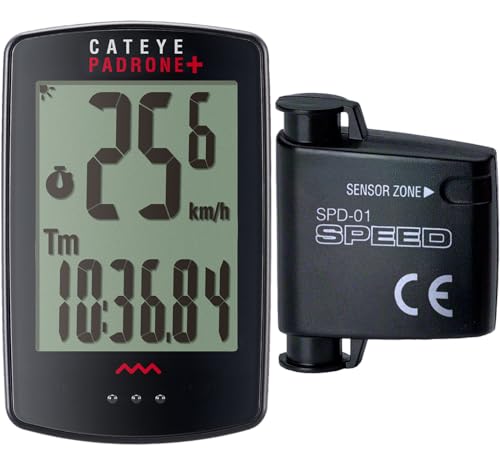
The CATEYE Padrone Plus is one of the more focused wireless bike computers, concentrating on essential speed, distance, time, and clock readings. Its large display, programmable backlight, ClickTec controls, and FlexTight bracket suit riders who want an easy-to-use cycling computer.
Best For: Road and recreational cyclists who want clear core ride statistics without GPS navigation.
Pros:
Shows current, average, and maximum speed, trip and total distance, elapsed time, and clock.
Programmable backlight supports daytime and nighttime riding.
ClickTec interface and FlexTight bracket simplify operation and mounting.
Manual total-distance setting preserves mileage after battery changes.
Cons:
Uses a speed sensor rather than GPS route tracking.
Its proprietary wireless system does not provide the broader sensor connectivity of ANT+ or Bluetooth models.
For riders who mainly need dependable speed and distance information, the Padrone Plus offers a clean, low-distraction design with useful night-riding features.
The COOSPO CS500 is a feature-rich option among wireless bike computers, combining GPS navigation, extensive data customization, Bluetooth and ANT+ connectivity, and bike-radar support. Its 2.6-inch display and 45-hour battery make it suited to longer and more demanding rides.
Best For: Experienced cyclists who want navigation, sensor compatibility, extensive metrics, and radar support.
Pros:
Uses multiple satellite systems for route, speed, and distance tracking.
Provides preloaded maps, turn prompts, and more than 140 cycling metrics.
Connects with Bluetooth and ANT+ sensors, trainers, and power meters.
Offers bike-radar support, automatic backlight, IPX7 protection, and 45-hour battery life.
Cons:
Its extensive features may be more than casual riders need.
Radar functionality requires a compatible radar light.
The CS500 is the strongest fit here for riders building a connected cycling setup, especially those who value navigation, training data, long battery life, and added awareness from bike-radar compatibility.
The Planet Bike Protegé 9.0 is a classic wireless bike computer built around nine practical functions, including speed, ride time, distance, temperature, and a clock. Its four-line display and universal handlebar or stem bracket make it a useful choice for riders who want several readings visible without GPS.
Best For: Commuters and recreational cyclists who want traditional wireless ride tracking with a broad set of basic functions.
Pros:
Tracks current, average, and maximum speed, ride time, trip distance, clock, and temperature.
Dual odometer supports two wheel sizes.
Four-line LCD can show up to five pieces of data at once.
Includes a universal mounting bracket and limited lifetime warranty.
Cons:
Does not provide GPS navigation, route recording, or app syncing.
The sensor connection is wired even though the main unit uses wireless technology.
The Protegé 9.0 favors useful at-a-glance information and long-term simplicity over connected features, making it a solid traditional alternative to GPS wireless bike computers.
The CATEYE Padrone is a straightforward choice among wireless bike computers for riders who want core ride data without GPS setup or complicated menus. Its oversized, high-contrast display shows speed, distance, time, and more, while the included out-front mount keeps the information easy to see.
Best For: Commuters, recreational cyclists, and riders who prefer simple wireless speed and distance tracking.
Pros:
Large inverted LCD display with an included out-front bracket.
Tracks current, maximum, and average speed, plus trip and total distance.
Auto start/stop pauses time and average-speed calculations during stops.
ClickTec design makes switching functions quick and uncomplicated.
Cons:
Uses analog wireless connectivity rather than GPS, ANT+, or Bluetooth.
Does not provide advanced metrics such as cadence, heart rate, or altitude.
The Padrone focuses on dependable essentials and easy readability. Choose it if you want a low-fuss wireless bike computer for everyday riding rather than navigation or training analysis.
The ROCKBROS is a feature-rich option among wireless bike computers, combining a 2.9-inch LCD with GPS, Beidou, GLONASS, and Galileo positioning. It supports extensive data customization and includes a cadence sensor, making it suited to riders who want more information than basic speed and distance.
Best For: Cyclists who want customizable ride pages, positioning support, and included cadence tracking.
Pros:
Offers 25 selectable data items and up to five customizable pages.
Supports GPS, Beidou, GLONASS, and Galileo positioning systems.
Includes a cadence sensor, mount, protective case, charging cable, and mounting accessories.
Automatic backlight adjustment is designed for daytime and nighttime readability.
Cons:
Heart-rate, power, and some other metrics require additional compatible devices.
Battery-life claims vary in the supplied details, listing over 60 hours maximum and a 35-hour average.
The ROCKBROS offers a broad feature set and a generous accessory bundle. It is a strong fit for data-focused riders, provided they are comfortable configuring multiple pages and pairing optional sensors.
The XOSS G+ is a practical GPS-based choice among wireless bike computers, pairing ANT+ and Bluetooth connectivity with XOSS app support. Its automatic-backlight display, IPX7 water resistance, and Strava synchronization make it useful for riders who want recorded routes and connected training data.
Best For: Cyclists who want GPS ride recording, app connectivity, and compatibility with optional heart-rate or cadence sensors.
Pros:
Supports GPS tracking and Bluetooth synchronization with the XOSS app.
Ride data can automatically sync to Strava through the app.
IPX7 water resistance helps it handle rainy riding conditions.
Supports optional ANT+ or Bluetooth heart-rate and cadence sensors.
Cons:
The 1.8-inch screen is smaller than the displays on the other listed models.
Heart-rate and cadence sensors must be purchased separately.
Battery life is listed at 25 hours, which may require more frequent charging for long-term use.
The XOSS G+ balances GPS recording and connected features in a compact, waterproof unit. It makes the most sense for riders who value app and Strava integration and are willing to use a smaller display.
For riders comparing wireless bike computers, the ROCKBROS M1 stands out for its broad data selection, included cadence sensor, and four-system positioning. Its 2.9-inch LCD can display up to 25 metrics across five customizable pages.
Best For: Cyclists who want customizable ride data and cadence tracking without buying extra setup accessories.
Pros:
Offers 25 selectable data items, with up to five customizable pages.
Includes a cadence sensor, mount, protective case, charging cable, and mounting accessories.
Uses GPS, BeiDou, GLONASS, and Galileo for positioning.
Automatic backlight adjustment and a rechargeable battery rated for up to 60 hours.
Cons:
Heart rate and power data require compatible additional devices.
Automatic brightness functions require the time zone to be set in advance.
The listed average battery life is 35 hours, below the maximum claimed runtime.
The M1 is a versatile option for riders who value data customization and a complete package. It is especially appealing if cadence tracking is important and you want ANT+ and Bluetooth compatibility for future accessories.
This wireless bike computer focuses on straightforward readability and basic ride tracking. Its 3-inch LCD, physical buttons, automatic scan function, and IP54 rating make it a practical choice for riders who prefer simple controls over advanced connectivity.
Best For: Casual cyclists who want a large, easy-to-read display for core speed, distance, and ride statistics.
Pros:
Large 3-inch LCD with soft white backlight for day or night viewing.
Provides 20 functions, including speed, distance, ride time, calories, temperature, and stopwatch data.
Wireless design avoids tangled handlebar cables.
Includes two bracket options for different handlebar setups.
Cons:
Tracks speed with a sensor but does not list GPS positioning.
IP54 protection is more limited than higher-rated waterproof designs.
Connectivity is listed as wireless rather than ANT+ or Bluetooth.
This model is a sensible low-complexity option for everyday rides. The oversized screen and scan function help keep key statistics visible, while the lack of GPS and advanced sensor connectivity makes it better suited to basic cycling needs.
Among wireless bike computers, the ROCKBROS M1 Pro is geared toward longer rides and connected training. It combines five-system GNSS positioning, customizable data fields, ANT+ and Bluetooth 5.0, smartphone syncing, and up to 70 hours of battery life.
Best For: Endurance riders and cyclists who want route recording, sensor connectivity, and long battery runtime.
Pros:
Five-system GNSS supports route, speed, distance, and elevation recording.
ANT+ and Bluetooth 5.0 support compatible speed, cadence, heart-rate, and power sensors.
Stores up to 150 hours of ride data and can sync with smartphone apps for ride reviews and Strava uploads.
Offers up to 70 hours of battery life, Type-C charging, and IPX6 water resistance.
Cons:
Compatible sensors are needed for heart-rate, cadence, and power measurements.
The time zone must be set initially for all functions to work properly.
Its advanced features may be more than casual riders need.
The M1 Pro is the strongest fit here for data-focused and long-distance cyclists. Its GNSS coverage, sensor support, app syncing, and extended battery make it more capable than a basic wireless speedometer, while the included mount and protective cover simplify installation.
We focused on the features that matter during real rides: reliable speed and distance readings, readable displays, straightforward mounting, wireless sensor or GPS connectivity, and useful battery life. We also considered whether each model suits road cycling, commuting, mountain biking, training, or casual recreational use.
GPS computers generally offer broader ride data and route features, while traditional wireless computers can be simpler, lighter, and easier to operate. Because the list includes both types, we evaluated each product according to its intended use rather than treating every model as a direct substitute.
Quick Comparison
Best for GPS tracking: Choose a COOSPO or XOSS model when route recording, GPS speed, and ride data are priorities.
Best for simple displays: CATEYE and Planet Bike computers are practical choices for speed, distance, and everyday cycling metrics.
Best for cadence data: Look for a model bundled with speed and cadence sensors, such as compatible ROCKBROS options.
Best for easy visibility: Oversized-display computers are useful for commuters and riders who want quick, glanceable readings.
Key Buying Factors for Wireless Bike Computers
GPS Versus Wheel or Sensor-Based Tracking
GPS models can calculate speed and distance without a wheel magnet and may record routes, but they require satellite reception and regular charging. Sensor-based computers often provide dependable basic metrics with longer battery life, though installation and wheel-size setup matter.
Display Size and Readability
A large LCD is easier to read at a glance, especially in traffic or on rough roads. Check whether the display shows multiple fields simultaneously and whether contrast remains usable in bright sunlight.
Connectivity and Compatibility
If you use heart-rate monitors, cadence sensors, or other training accessories, confirm support for Bluetooth, ANT+, or the specific sensor standard you already own. Wireless pairing is convenient, but compatibility varies between computers and accessories.
Mounting, Weather Protection, and Battery
Look for a secure handlebar mount, a water-resistant design, and a battery system that matches your routine. Rechargeable GPS units suit frequent data tracking; coin-cell computers may be better for low-maintenance commuting.
Who Should Buy Which Wireless Bike Computers?
Casual riders and commuters should prioritize a clear display, simple controls, and long battery life over advanced navigation. Road cyclists and fitness riders may benefit from GPS recording, cadence support, and multiple data screens. Mountain bikers should look for weather resistance, a secure mount, and GPS performance suited to varied terrain. Budget-conscious buyers can choose a basic wireless computer for essential speed and distance data, while riders building a training setup should select a model with broader sensor compatibility and room to expand.