The best bike computers make it easier to follow routes, track performance, and ride with fewer distractions. This roundup compares 10 standout options, from simple wired speedometers to advanced touchscreen GPS units.
Whether you want reliable navigation, structured training data, or an affordable upgrade for an everyday bike, the right model depends on your riding style, sensors, and preferred controls.
The Garmin Edge 1050 is a premium choice among bike computers for riders who want advanced navigation, training tools, connectivity, and a vivid touchscreen. It combines a 3.5-inch color display with detailed cycling metrics, course planning, and smart safety features.
Best For: Serious cyclists and riders who want comprehensive training, navigation, and group-ride features.
Pros:
Large, vivid touchscreen with responsive course creation and road-surface information.
Advanced tools include ClimbPro, power guidance, personalized coaching, and real-time stamina and wind adjustments when paired with compatible sensors.
Built-in speaker supports navigation prompts, a bike bell, and connectivity features such as incident alerts and group messaging with a compatible smartphone.
Battery life reaches up to 20 hours in demanding use or 60 hours in battery-saver mode.
Cons:
Many advanced training and connectivity features require compatible sensors, a smartphone, or the Garmin Connect app.
Its premium feature set may be more than casual riders need.
The Edge 1050 stands out for riders who want one of the most feature-rich bike computers available. Its bright interface, robust navigation, and deep performance tools make it especially suitable for structured training and long, connected rides.
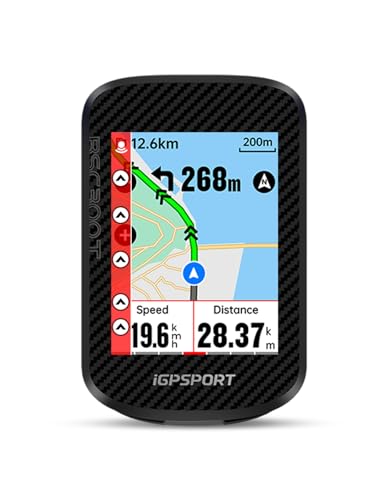
The iGPSPORT BSC500 is a versatile option among bike computers, combining a 3.3-inch touchscreen with button controls, route importing, voice navigation, and automatic rerouting. Its dual-band positioning and support for five satellite systems are designed to improve navigation accuracy on varied rides.
Best For: Riders who want touchscreen navigation, route flexibility, and training features at a practical price point.
Pros:
Supports both touchscreen and button operation while displaying up to 12 cycling data fields per page.
Imports routes from the iGPSPORT app, Strava, Komoot, and compatible route files.
IPX7 protection, Bluetooth and ANT+ support, and a two-year warranty add practical versatility.
Cons:
At 107 grams, it is heavier than some compact cycling computers.
Several connected features depend on compatible apps, sensors, or accessories.
The BSC500 offers a strong mix of navigation and ride-data features for cyclists who want more guidance than a basic speedometer provides. Its touchscreen, voice cues, and automatic rerouting are particularly useful for exploring unfamiliar routes.
The Garmin Edge Explore 2 is an approachable option among bike computers for riders who prioritize straightforward navigation. Its 3-inch rain- and glove-friendly touchscreen, preloaded activity profiles, ride-type maps, and eBike routing make it easy to use across road, trail, indoor, and assisted rides.
Best For: Recreational cyclists, touring riders, and eBike users who want simple GPS navigation and connected safety features.
Pros:
High-resolution touchscreen remains usable with gloves, rain, and direct sunlight.
Preloaded road, off-road, and indoor profiles simplify setup.
Maps include popular roads, trails, searchable points of interest, traffic information, and eBike routing.
Works with a compatible smartphone, sensors, and Varia devices for features such as LiveTrack, incident detection, and cycling awareness.
Cons:
Battery life is rated at up to 16 hours, less than some endurance-focused models.
Heart-rate, cadence, speed, and Varia features require compatible accessories sold separately.
The Edge Explore 2 favors ease of use over deep performance analysis. It is a practical fit for riders who want reliable route guidance and useful connected features without the more specialized training focus of Garmin’s premium computers.
The CATEYE Wired Bike Computer is a straightforward entry-level choice among bike computers. It tracks essential speed, distance, time, pace, and clock data without GPS, smartphone pairing, or complicated setup, making it suitable for riders who want clear ride feedback.
Best For: Beginner cyclists and riders who need basic speed and distance tracking for road, mountain, or gravel bikes.
Pros:
Displays current, maximum, and average speed, total and trip distance, elapsed time, pace arrow, and clock.
Automatic stop detection pauses time and average-speed calculations during stops.
Alkaline battery lasts up to three years.
Includes the computer, bracket, sensor, magnet, and zip ties for installation.
Cons:
Wired connectivity and a speed sensor provide fewer features than GPS bike computers.
It does not provide navigation, mapping, smartphone connectivity, or advanced training metrics.
The CATEYE Velo 7 keeps cycling data simple and accessible. Choose it when dependable speedometer and odometer functions matter more than route guidance, wireless connectivity, or detailed performance analysis.
For cyclists who want training guidance alongside navigation, the Garmin Edge 540 is one of the most feature-rich bike computers in this group. Its button-based interface, multi-band GNSS, adaptive coaching tools, and long battery life suit serious road and mixed-surface riding.
Best For: Training-focused cyclists who want detailed performance tools and reliable positioning.
Pros:
Up to 26 hours of battery life in demanding use, or up to 42 hours in battery-saver mode.
Multi-band GNSS supports enhanced positioning accuracy in challenging environments.
Offers ClimbPro, suggested workouts, adaptive coaching, stamina insights, and power guidance when paired with compatible sensors.
Ride-type-specific maps highlight popular roads, trails, and searchable points of interest.
Cons:
The 2.6-inch LCD uses button controls rather than a touchscreen.
Several advanced training features require compatible power and heart-rate sensors.
The Edge 540 is a strong choice when training analysis matters as much as turn guidance. It is less appealing for riders who specifically prefer touchscreen operation or who do not use external sensors.
The iGPSPORT BSC300T is a versatile option for riders seeking touchscreen controls, offline maps, and broad sensor compatibility without giving up useful navigation features. It supports road bikes, mountain bikes, and ebikes, with route alerts and extensive ride-data tracking.
Best For: Riders who want offline mapping, off-course warnings, and ebike support.
Pros:
Combines a 2.4-inch touchscreen with six buttons for flexible operation.
Provides more than 130 riding metrics, including speed, distance, grade, cadence, calories, and temperature.
Works with ANT+ and Bluetooth sensors and supports ebike data, real-time tracking, and sharing to Strava or Komoot.
Cons:
Its listed battery life is 20 hours, shorter than some larger-capacity options.
A USB-C cable is not included according to the supplied details.
With offline navigation and a practical mix of touchscreen and button controls, the BSC300T offers broad functionality for its size. Consider it especially if route correction and ebike compatibility are priorities.
The Wahoo ELEMNT BOLT V3 focuses on straightforward route guidance and connected riding. Its on-device turn prompts, automatic route downloads, smart notifications, and radar integration make it a practical choice for cyclists who ride with a smartphone and compatible accessories.
Best For: Connected road cyclists who prioritize route syncing, alerts, and radar support.
Pros:
Provides on-device turn-by-turn prompts for GPX, TCX, Strava, Ride With GPS, and Komoot routes.
Automatically downloads saved routes and uploads completed rides through compatible connected accounts.
Supports destination-based route generation through the device or companion app.
Integrates with ANT+ rearview radar and displays approaching vehicles with screen and LED alerts.
Cons:
Battery life is listed at 20 hours.
Smart notifications and LiveTrack require a connected smartphone.
The button-controlled display is 2.3 inches and does not provide touchscreen input.
The ELEMNT BOLT V3 is well suited to riders who want a streamlined experience built around synced routes and connected features. Its strongest advantages depend on using a smartphone and compatible services or radar hardware.
The iGPSPORT BSC200S is a practical choice among bike computers for riders who want wireless route navigation, broad sensor compatibility, and a clear color display without moving to a larger unit. Its app supports routes from iGPSPORT, Strava, Ride with GPS, and Komoot, while the 25-hour battery suits long day rides.
Best For: Route-focused riders who want long battery life, turn guidance, and ANT+/Bluetooth connectivity.
Pros:
Supports route creation and imports from popular third-party platforms, with turn and yaw reminders.
2.4-inch sunlight-readable color display and more than 100 customizable riding metrics.
Connects with compatible iGPSPORT lights and radar lights, and stores up to 400 hours of ride data.
IPX7 waterproofing and up to 25 hours of battery life support all-weather, long-distance rides.
Cons:
Type-C charging cable is not included.
Its button-based interface may feel less immediate than a touchscreen computer.
The BSC200S balances navigation, training data, and connected accessories in a compact 67-gram design. It is especially appealing if you already use supported route platforms or iGPSPORT accessories.
The COOSPO BC107-B-L is one of the more straightforward bike computers for riders who prioritize extended recording time and essential GPS data. Its 2.4-inch display has automatic backlighting, while the CoospoRide app handles setup, route loading, firmware updates, activity analysis, and Strava syncing.
Best For: Riders who want a simple GPS computer with exceptionally long battery life and optional ANT+ sensors.
Pros:
Records up to 80 hours of riding data and uses a sunlight-readable 2.4-inch screen.
Supports ANT+ heart-rate, speed, cadence, and power sensors.
IP67 protection helps it operate during rainy rides.
Cons:
The out-front mount is sold separately.
Additional sensors are not included with the single computer option.
Initial GPS positioning can take three to five minutes outdoors.
This model is a sensible pick for riders who prefer core ride tracking over a feature-heavy touchscreen experience. Its main advantage is endurance, though you should confirm whether the selected package includes the sensors you need.
The COOSPO CS600 is a feature-rich option among bike computers, combining a responsive 2.4-inch color touchscreen with route navigation, advanced satellite tracking, and extensive training data. Its 36-hour battery and ecosystem support make it suited to riders who want a more integrated cockpit.
Best For: Performance-oriented cyclists who want touchscreen navigation, customizable dashboards, and smart accessory connectivity.
Pros:
High-resolution color touchscreen with auto-backlight for easier viewing and control.
Supports GPS and GLONASS tracking, breadcrumb routes, and on-screen navigation.
Offers more than 150 data insights and customizable display layouts.
36-hour battery, IPX7 waterproofing, and compatibility with lights, radar tail lights, e-bikes, shifters, and trainers.
Cons:
Additional sensors and extension mounts are sold separately.
At 120 grams, it is heavier than the iGPSPORT BSC200S.
The CS600 is the strongest fit here for riders who value richer navigation and data presentation over minimalism. Its touchscreen and broad ecosystem are compelling, but budgeting for compatible accessories may be necessary for full performance tracking.
We selected these models across several use cases, including road cycling, touring, commuting, mountain biking, e-bike riding, and basic speed tracking. Our comparison focuses on navigation quality, display usability, sensor compatibility, battery expectations, weather resistance, mounting convenience, and overall value.
We also considered the difference between full GPS cycling computers and simpler wired or wireless units. Advanced models can support route guidance, training metrics, and third-party sensors, while entry-level computers may be better for riders who only need speed, distance, and ride time.
Quick Comparison
Best premium option: Garmin Edge 1050 for feature-rich training, navigation, and a large touchscreen.
Best for easy navigation: Garmin Edge Explore 2 for riders who prioritize route guidance over advanced performance analysis.
Best compact training computer: Garmin Edge 540 for physical controls and detailed ride data in a smaller format.
Best enthusiast alternative: Wahoo ELEMNT Bolt V3 for streamlined controls and connected cycling features.
Best budget GPS choices: iGPSPORT and COOSPO models with route support, wireless connectivity, and weather-resistant designs.
Best basic option: CATEYE Wired Bike Computer for straightforward speed and distance tracking without GPS complexity.
Key Buying Factors for Bike Computers
Navigation and Maps
Check whether a computer offers turn-by-turn directions, downloadable maps, rerouting, off-course alerts, or only a basic breadcrumb trail. Riders exploring unfamiliar roads should prioritize clear route guidance and readable map detail.
Display and Controls
Touchscreens are convenient for browsing maps, but physical buttons can be easier to operate with gloves, rain, or rough surfaces. Screen size, brightness, contrast, and automatic backlighting also affect readability in real-world conditions.
Sensor and App Compatibility
If you use a heart-rate monitor, power meter, cadence sensor, radar, smart trainer, or e-bike system, verify support for Bluetooth, ANT+, or the relevant manufacturer ecosystem. App syncing is equally important for reviewing rides and uploading routes.
Battery and Durability
Compare claimed battery life with your typical ride length and remember that navigation, bright displays, sensors, and frequent rerouting can reduce runtime. IP-rated water resistance is useful for unpredictable weather, while a secure mount matters on rough roads.
Who Should Buy Which Bike Computers?
Choose a premium Garmin or Wahoo computer if you train regularly, use multiple sensors, or need detailed navigation and performance data. Choose an Explore-style navigator if simple route planning and dependable guidance matter more than advanced metrics.
Choose an iGPSPORT or COOSPO GPS model if you want useful navigation and wireless features at a lower price. These are practical choices for recreational riders, commuters, and e-bike owners. Choose the CATEYE wired computer if you only need essential ride statistics and prefer a simple, low-maintenance setup.