The best bike computers with Komoot make it easier to follow planned routes, monitor your ride, and stay on course without relying entirely on your phone. This roundup compares 10 options across navigation features, display sizes, sensor support, battery life, and price.
Whether you want a compact computer for everyday rides or a premium model for long-distance cycling, use the guide below to match the right features to your riding style.
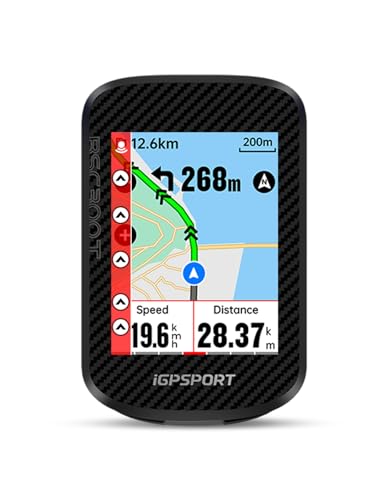
For riders seeking bike computers with komoot support, the iGPSPORT BSC500 combines route imports with a large touchscreen, voice guidance, and automatic rerouting. Its dual-band, multi-satellite positioning is designed to improve accuracy on varied rides.
Best For: Riders who want touchscreen control, Komoot route imports, and voice navigation.
Pros:
Imports routes from Komoot, Strava, and compatible route files.
3.3-inch touchscreen also supports button operation and displays up to 12 data fields per page.
Provides voice alerts, automatic turn-warning adjustments, and off-course rerouting.
IPX7 protection and up to 2 years of stated warranty coverage.
Cons:
At 107 g, it is heavier than the listed Wahoo and Garmin options.
Touchscreen operation may not suit riders who prefer button-only controls.
The BSC500 is a feature-rich choice for navigation-focused cyclists. Its Komoot compatibility, loudspeaker prompts, and yaw replanning reduce the need to stop and check a phone, while the climb-planning and training features add value for more structured riding.
The Garmin Edge 540 is a compact option among bike computers with komoot, offering button controls, advanced navigation, and extensive training tools. It is built around performance analysis, adaptive coaching, and long battery life rather than touchscreen interaction.
Best For: Training-focused cyclists who prefer physical buttons and long battery endurance.
Pros:
Up to 26 hours of battery life in demanding use, or up to 42 hours in battery-saver mode.
Multi-band GNSS supports enhanced positioning accuracy in challenging environments.
Offers ClimbPro, daily suggested workouts, adaptive coaching, stamina insights, and power guidance with compatible sensors.
Ride-type-specific maps highlight popular roads, trails, and searchable points of interest.
Cons:
Uses button controls rather than a touchscreen.
Several advanced training insights require compatible power and heart-rate sensors.
The supplied notes do not specifically describe direct Komoot route importing.
The Edge 540 is strongest for cyclists who want training guidance and dependable navigation in a compact, button-operated unit. Its battery-saver runtime is particularly useful for long rides, while sensor-dependent features can expand its analysis capabilities.
The Hammerhead Karoo is a strong candidate for riders comparing bike computers with komoot and prioritizing a touchscreen interface, map handling, and broad device connectivity. Its multi-band GNSS is intended to maintain precise tracking across city roads and rougher trails.
Best For: Riders who want touchscreen map interaction and connectivity with SRAM AXS, e-bikes, and ANT+ accessories.
Pros:
Combines touchscreen and button input for flexible ride control.
Multi-band GNSS supports accurate tracking in varied environments.
Connects with SRAM AXS products, e-bikes, ANT+ lights, and other compatible devices.
Provides ample memory and faster map rendering according to the supplied notes.
Cons:
Listed battery life is approximately 15 hours, shorter than the Garmin and Wahoo options here.
The supplied notes do not specifically confirm Komoot route importing.
Its 0.41 kg listed weight is relatively high for a bike computer.
The Karoo suits riders who value a modern touchscreen experience and an accessory-rich setup. It offers useful navigation hardware and broad connectivity, but its shorter stated battery life may matter for ultra-distance or multi-day riding.
The Wahoo ELEMNT BOLT V3 is a practical pick among bike computers with komoot because it supports automatic route downloads and turn-by-turn prompts for Komoot routes. LEDs, audible cues, smart notifications, and radar integration add useful information without requiring constant screen checks.
Best For: Riders who want streamlined Komoot syncing, compact button controls, and safety-focused alerts.
Pros:
Automatically downloads saved Komoot routes when linked accounts are synced.
Provides on-device turn prompts, top LEDs, and audible off-course cues.
Supports on-demand route generation from the device or companion app.
Offers smart notifications, LiveTrack, and ANT+ rearview radar integration.
Cons:
Its 2.3-inch display is smaller than the BSC500 and Karoo screens.
Navigation and LiveTrack features that use the companion app require a smartphone.
Uses button controls only.
The BOLT V3 is especially convenient for Komoot users who want routes to sync with minimal effort. Its compact design, 20-hour battery rating, and clear LED and audio alerts make it a balanced option for everyday road, gravel, and commuting rides.
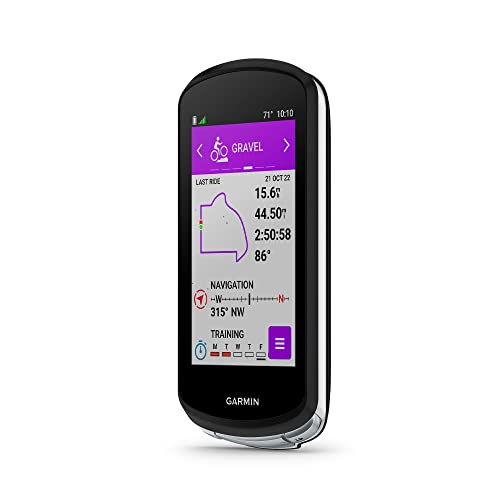
For riders comparing bike computers with komoot, the Garmin Edge 1040 Solar stands out for its extensive navigation, training, and connectivity features. Its solar-charging lens can extend battery life during rides, while multi-band GNSS helps improve positioning in challenging environments.
Best For: Long-distance cyclists who want advanced training metrics, broad navigation support, and extended battery performance.
Pros:
Solar charging provides up to 100 hours in battery-saver mode or up to 45 hours in demanding use cases.
Supports Komoot, Strava, TrainingPeaks, and other smart-device platforms.
Combines multi-band GNSS, ride-type-specific maps, power guidance, and stamina insights.
Includes touchscreen controls, multiple mounts, a silicone case, and IPX7 protection.
Cons:
Advanced features such as power guidance and stamina insights require compatible sensors.
Its extensive feature set may be more than casual riders need.
The Edge 1040 Solar is a feature-rich choice for riders who want Komoot-compatible route planning alongside serious performance analysis. Its solar capability and included mounting options also suit extended adventures.
The iGPSPORT BiNavi is a practical option for riders seeking bike computers with komoot support and a large color touchscreen. Routes can be sent through the iGPSPORT app or imported from third-party apps such as Komoot and Strava, with automatic replanning when you go off course.
Best For: Touring and recreational riders who want touchscreen navigation, route imports, and convenient smartphone-linked features.
Pros:
Imports routes from Komoot, Strava, and supported road-book files.
Automatically replans a route after going off course.
Offers a 3.5-inch touchscreen, dual-band GPS, and support for five satellite systems.
Includes music control, saved-point navigation, climb planning, and a 35-hour battery.
Cons:
Some functions depend on pairing with a smartphone or using the iGPSPORT app.
The supplied notes do not specify the current software-update support date.
With broad route-import support and automatic rerouting, the BiNavi is especially appealing for riders who build trips in Komoot. Its climb planning and music controls add useful convenience without requiring multiple devices.
The COOSPO CS600 is a compact choice for riders evaluating bike computers with komoot-style route workflows. It provides built-in route navigation and breadcrumb trails, plus wireless connectivity for compatible sensors, radar, lights, e-bikes, and trainers.
Best For: Riders who want a waterproof touchscreen computer with route following, long battery life, and broad accessory connectivity.
Pros:
Provides built-in route navigation and breadcrumb trail following.
Offers a 36-hour battery and IPX7 waterproof protection.
Supports Bluetooth and ANT+ connections for radar, lights, shifters, trainers, and other accessories.
Includes a color touchscreen, auto-backlight, and more than 150 data insights.
Cons:
Additional sensors and extension mounts are sold separately.
The supplied notes specifically mention automatic syncing to Strava and TrainingPeaks, but do not confirm direct Komoot syncing.
The CS600 makes sense for riders who value durable, weatherproof route following and a lengthy battery. If direct Komoot integration is essential, verify the app workflow before buying, since the supplied specifications do not explicitly confirm it.
The iGPSPORT BSC300T is a strong option among bike computers with komoot if you want offline maps, touchscreen controls, and route correction alerts. It supports routes shared from Komoot through the iGPSPORT app, while its global offline map support and off-course warning add useful guidance when riding beyond familiar roads.
Best For: Riders who want touchscreen navigation, offline maps, and broad sensor and e-bike compatibility.
Pros:
Supports route sharing to Komoot through the iGPSPORT app.
Provides more than 130 riding metrics with ANT+ and Bluetooth connectivity.
Supports e-bike data, real-time tracking, and five satellite systems.
Cons:
The Type-C charging cable is not included.
Touchscreen operation may be less convenient than button-only controls in some riding conditions.
Choose the BSC300T when navigation flexibility is more important than a minimalist display. Its 20-hour battery, 8 GB of storage, and worldwide offline map support make it practical for extended route exploration.
The iGPSPORT BSC200S is a practical pick among bike computers with komoot for riders who prefer straightforward route navigation and long battery life. You can import Komoot routes through the iGPSPORT app, use one-touch navigation, and receive turn, yaw, and direction reminders on its 2.4-inch color display.
Best For: Long-distance riders who want reliable route importing, simple button controls, and extended battery life.
Pros:
Imports routes from Komoot and other third-party platforms through the app.
Provides one-touch navigation, Back to Start, and riding-record navigation.
Offers up to 25 hours of battery life and stores up to 400 hours of riding data.
IPX7 waterproofing and ANT+/Bluetooth support suit varied riding conditions.
Cons:
The Type-C charging cable is not included.
Navigation depends on creating or importing routes through the companion app.
The BSC200S is a sensible choice if you want Komoot route support without paying for a larger touchscreen computer. Its button-based interface, customizable data pages, and 25-hour battery favor dependable everyday and touring use.
The Magene C706 is a premium choice among bike computers with komoot, combining full map navigation with voice guidance and a large 3.3-inch color touchscreen. Its dual-band GNSS, offline route planning, Wi-Fi synchronization, and compatibility with advanced training features make it suited to riders who want more than basic turn prompts.
Best For: Performance-focused cyclists who want voice-guided navigation, detailed maps, and training-oriented features.
Pros:
Provides map-based turn-by-turn navigation with voice prompts in 13 languages.
Uses dual-band, five-satellite GNSS for positioning in cities and forests.
Supports offline route planning up to 1,000 km and Wi-Fi syncing.
Adds ClimbPro, Strava Live Segments, smart-trainer control, and camera/light integration.
Cons:
Its advanced feature set may be more than casual riders need.
Some training and cycling-dynamics functions require compatible devices or power meters.
The C706 stands out for riders who want navigation and performance analysis in one larger unit. Its 25-hour battery and IPX7 rating support serious rides, while the touchscreen and voice guidance reduce the need to look down for directions.
We focused on cycling computers that can work effectively with Komoot-planned routes through route transfer, smartphone connectivity, or compatible navigation ecosystems. We also considered screen readability, turn-by-turn guidance, map support, battery performance, weather resistance, sensor compatibility, and ease of setup.
The selection covers a broad range of needs, including affordable GPS computers, touchscreen models, compact performance units, large-screen navigation devices, and premium computers designed for touring or serious training. Compatibility can vary by firmware, phone, and app version, so check the manufacturer’s current specifications before buying.
Quick Comparison
Best For
What to Look For
Everyday riders
Reliable GPS, clear data fields, simple route syncing, and good battery life
Navigation-focused cyclists
Color maps, turn prompts, rerouting or off-course alerts, and readable screen controls
Training-focused riders
ANT+ and Bluetooth sensor support, structured workouts, and detailed performance data
Touring and endurance riders
Long battery life, strong weather protection, large storage, and dependable navigation
E-bike users
Compatible motor data fields, route guidance, and connectivity with relevant accessories
Key Buying Factors for Bike Computers with Komoot
Route Transfer and Navigation
Confirm how routes move from Komoot to the computer. Some devices use a direct account connection, while others depend on a companion phone app. Turn-by-turn prompts, offline maps, voice guidance, climb information, and off-course warnings can make a major difference when riding unfamiliar roads.
Screen and Controls
Touchscreens are convenient for browsing maps and changing settings, but physical buttons can be easier to use in rain or with gloves. Consider screen size, color contrast, backlight performance, and whether the display remains readable in direct sunlight.
Battery, Sensors, and Durability
Match battery capacity to your longest rides, allowing extra power for navigation, sensors, and screen brightness. ANT+ and Bluetooth support expands compatibility with heart-rate monitors, cadence sensors, power meters, radar, and smart trainers. An IPX7 rating or similar water resistance is useful for unpredictable weather.
Who Should Buy Which Bike Computers with Komoot?
Choose a compact, button-controlled model if you mainly need speed, distance, route prompts, and dependable battery life. A touchscreen computer is better for riders who frequently inspect maps, adjust routes, or prefer phone-like controls. Training-oriented cyclists should prioritize broad sensor compatibility and customizable data screens.
For bikepacking, touring, and ultra-distance rides, favor a large display, strong navigation tools, ample battery capacity, and easy charging. E-bike riders should verify support for their motor system and the data they want displayed. Finally, if you already use Komoot regularly, confirm account integration and route-sync behavior before purchase rather than assuming every GPS computer handles the app identically.