A bike computer with barometric altimeter can make elevation data, climbing metrics, and route guidance more useful than GPS alone. The right model helps you understand every ascent while keeping key ride information easy to see.
We compare 10 cycling computers across navigation, mapping, connectivity, screen design, battery life, weather resistance, and training features to help you choose with confidence.
Best 10 Bike Computer with Barometric Altimeter Picks for 2026
The Garmin Edge 540 is a strong all-around choice for riders seeking a bike computer with barometric altimeter capabilities, advanced navigation, training guidance, and long battery life. Its button-based controls and multi-band GNSS are practical for demanding rides and varied conditions.
Best For: Riders who want detailed training tools, climbing data, and reliable navigation in a compact format.
Pros:
Up to 26 hours of battery life in demanding use, or up to 42 hours in battery-saver mode
ClimbPro shows remaining ascent and grade, including on rides without a planned course
Multi-band GNSS is designed to improve positioning accuracy
Adaptive workout suggestions and training prompts support structured riding
Cons:
Button controls may be less intuitive than a touchscreen for some riders
Some advanced training features require compatible power and heart-rate sensors
The Edge 540 is especially compelling for cyclists who value performance analysis and climbing awareness. Its extensive feature set is best suited to riders willing to spend time configuring training and navigation tools.
The Hammerhead Karoo is a capable bike computer with barometric altimeter functionality for cyclists who prefer a touchscreen interface and detailed route management. Its multi-band GNSS, fast map rendering, and broad connectivity support make it suitable for navigation-focused rides.
Best For: Riders who prioritize touchscreen map control, route navigation, and compatibility with connected cycling equipment.
Pros:
3.2-inch touchscreen combines with buttons for flexible control
Multi-band GNSS supports accurate tracking in urban and rugged environments
Connects with SRAM AXS products, e-bikes, ANT+ lights, and other devices
Ample memory and extended battery design support map use and longer rides
Cons:
Listed battery life is 15 hours, shorter than several competing options
At 0.41 kg, it is relatively heavy for a cycling computer
The Karoo stands out when a responsive touchscreen and route-focused interface matter more than minimum weight or maximum battery runtime. Its connected-device support also suits riders building a feature-rich cockpit.
The Wahoo ELEMNT BOLT V3 is a compact bike computer with barometric altimeter support aimed at riders who want straightforward route guidance and connected ride features. Its automatic turn prompts, route syncing, and radar integration make it practical for road and mixed-route navigation.
Best For: Cyclists who want compact button controls, automatic route guidance, and compatibility with common training and safety accessories.
Pros:
Automatically provides turn-by-turn prompts for supported route files and services
Routes and completed rides can sync wirelessly through connected accounts
ANT+ radar integration displays approaching vehicles and provides LED alerts
IPX7-rated construction helps suit wet-weather riding
Cons:
Its 2.3-inch display is smaller than the screens on several alternatives
Live tracking and smart notifications require a smartphone connection
The BOLT V3 is a sensible choice for riders who want navigation without a large display or complicated controls. It is particularly useful for cyclists already using services such as Strava, Komoot, or Ride With GPS.
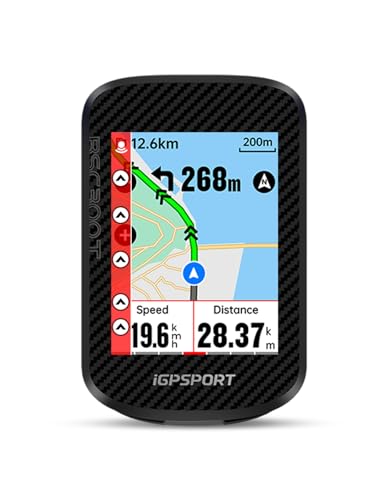
The iGPSPORT BSC500 is a practical bike computer with barometric altimeter capabilities, a large touchscreen, and voice navigation. Its dual-band, five-satellite positioning support and automatic rerouting make it a useful option for riders who want clear guidance and climbing-oriented planning.
Best For: Riders seeking a large display, voice prompts, automatic rerouting, and broad satellite compatibility.
Pros:
3.3-inch touchscreen supports up to 12 cycling data fields per page
Dual-band positioning supports GPS, BeiDou, GLONASS, Galileo, and QZSS
Voice navigation and speed-based turn warnings reduce the need to glance at the screen
Automatically replans routes after going off course and includes iClimb 2.0 planning
Cons:
The supplied notes do not specify battery-life capacity
At 107 g, it is heavier than some compact cycling computers
The BSC500 offers an appealing mix of screen size, route assistance, and satellite support. It is a good fit for riders who value audible guidance and easy-to-read data over the lightest possible setup.
The Wahoo ELEMNT ROAM V3 is a strong bike computer with barometric altimeter alternative for riders who prioritize navigation, route planning, and reliable GPS coverage. Its dual-band GPS, turn-by-turn routing, and 25-hour battery make it well suited to longer rides and unfamiliar roads.
Best For: Adventure cyclists and riders who want flexible route planning with broad sensor connectivity.
Pros:
Dual-band GPS supports accurate positioning in forests and dense urban areas.
Generates and imports turn-by-turn routes from multiple sources.
Offers 25 hours of battery life, Wi-Fi, Bluetooth, and ANT+-compatible sensor support.
Cons:
The supplied notes do not specify a barometric altimeter.
Its 2.8-inch LCD may provide less map space than larger navigation units.
Choose the ROAM V3 if dependable navigation and route sharing matter more than a confirmed barometric elevation sensor. The IPX7 rating and integrated mounting options also make it practical for everyday outdoor riding.
This compact bike computer with barometric altimeter-style elevation tracking is designed for riders who want altitude, gradient, and ascent data without a complicated setup. It combines a 2.4-inch display with automatic recording, a 28-hour battery, and IPX7 protection.
Best For: Road and mountain bikers who want straightforward elevation and ride metrics.
Pros:
Displays altitude, gradient, accumulated ascent, temperature, speed, and distance.
Built-in GPS works without a wheel sensor or spoke magnet.
Provides up to 28 hours of runtime and IPX7 waterproof protection.
Cons:
The supplied notes do not confirm that the elevation sensor is barometric.
The simple LCD layout may offer fewer navigation features than map-equipped computers.
For buyers specifically comparing a bike computer with barometric altimeter options, this model is attractive because elevation metrics are central to its feature set. Verify the sensor technology if barometric accuracy is an essential requirement.
The iGPSPORT BSC300T is a versatile bike computer with barometric altimeter alternative for cyclists who want offline maps, route warnings, and extensive ride data. Its touchscreen, physical buttons, multi-satellite positioning, and ANT+/Bluetooth connectivity support road, mountain, and e-bike use.
Best For: Riders who want offline navigation, broad device compatibility, and detailed performance data.
Provides more than 130 riding data fields, including grade, cadence, and temperature.
Works with ANT+ and Bluetooth sensors, e-bikes, smart trainers, and radar lights.
Cons:
The supplied notes do not specify a barometric altimeter.
Battery life is listed at 20 hours, shorter than some dedicated long-runtime options.
The BSC300T stands out when navigation and connectivity are more important than a confirmed barometric elevation sensor. Its lightweight 67-gram design and 2.4-inch touchscreen make it a capable choice for mixed-terrain and group riding.
The GEOID CC600 is a practical bike computer with barometric altimeter buyers may consider when they want route guidance, broad sensor compatibility, and indoor training features in a compact 2.4-inch color display. It supports GPX routes, automatic rerouting, Wi-Fi syncing, and GPS, BeiDou, GLONASS, QZSS, and Galileo positioning.
Best For: Riders who want customizable cycling data pages, navigation, and compatibility with multiple ANT+ and Bluetooth accessories.
Pros:
Color route navigation includes turn reminders, GPX uploads, and automatic rerouting.
Supports up to 108 data items across customizable pages and layouts.
Works with speed and cadence sensors, heart-rate monitors, power meters, trainers, radar lights, and electronic shifting systems.
Wi-Fi and Bluetooth support streamlined record, firmware, and AGNSS syncing.
Cons:
The display is smaller than the 2.8-inch screen on the CC700 Pro.
The supplied notes do not specify a barometric altimeter, so elevation functionality should be confirmed before purchase.
Battery life is listed at up to 24 hours.
The CC600 is a feature-rich choice for riders who value connectivity and configurable data more than a larger screen. Its 24-hour battery and wide accessory support suit regular training and navigation rides.
The COOSPO CS600 is a bike computer with barometric altimeter shoppers may compare for its touchscreen controls, route guidance, and extended battery life. Its 2.4-inch color display offers auto-backlighting, while Bluetooth and ANT+ connectivity support an expanded riding setup with compatible accessories.
Best For: Cyclists who prioritize long battery life, touchscreen operation, weather protection, and app-based ride syncing.
Pros:
36-hour battery life is suited to extended rides and multi-day adventures.
Auto-backlighting and a responsive color touchscreen improve visibility and control.
Provides route uploads, breadcrumb navigation, and customizable data dashboards.
IPX7 waterproof protection supports riding in heavy rain, and the unit connects with radar lights, e-bikes, shifters, and trainers.
Cons:
Cadence, heart-rate, and power data require compatible accessories sold separately.
The supplied notes do not specify a barometric altimeter, so elevation tracking should be verified.
Navigation is described as route and breadcrumb guidance rather than detailed offline color mapping.
The CS600 stands out for endurance and ease of use. It is a sensible option for riders who want a rain-ready touchscreen computer with broad ecosystem connectivity, provided they are comfortable purchasing sensors separately.
The GEOID CC700 Pro is a large-screen bike computer with barometric altimeter buyers may evaluate for offline map navigation, rerouting, and extensive wireless connectivity. Its 2.8-inch color touchscreen combines with three buttons, while 4GB of storage supports multiple downloaded routes.
Best For: Riders who want a larger navigation display, offline maps, automatic rerouting, and indoor smart-trainer support.
Pros:
2.8-inch color touchscreen provides a larger viewing area for navigation.
Offline maps offer turn prompts, street names, zoom, dual perspectives, and 4GB route storage.
Automatic rerouting helps when the connected bike computer goes off course.
Supports Wi-Fi, ANT+, Bluetooth, five satellite systems, and free indoor training features.
Cons:
Automatic rerouting requires the bike computer to remain connected to the designated app.
The supplied notes do not state battery life.
The supplied notes do not specify a barometric altimeter, so elevation measurement should be confirmed.
The CC700 Pro is the strongest navigation-focused option in this group, especially for riders who prefer a larger screen and offline mapping. Its app-dependent rerouting and unspecified battery rating are the main details to investigate before buying.
How We Picked the Best Bike Computer with Barometric Altimeter
We focused on models that combine GPS or GNSS positioning with elevation tracking and practical cycling features. The lineup includes compact computers for daily training, larger color-screen units for navigation, and affordable options for riders who want core metrics without a premium price.
Our comparisons emphasize route planning, map visibility, rerouting, sensor compatibility, touchscreen or button controls, battery endurance, waterproofing, wireless syncing, and support for ANT+ or Bluetooth accessories. Because barometric accuracy can vary with weather and calibration, we also considered how useful each computer is as part of a complete navigation and training setup.
Quick Comparison
Best for
What to prioritize
Structured training
Reliable elevation data, sensor support, workouts, and clear performance metrics
Turn-by-turn navigation
Color maps, rerouting, route syncing, and a readable display
Long-distance riding
Long battery life, weather resistance, and dependable GPS reception
Value-focused buyers
Accurate basic tracking, navigation essentials, and simple connectivity
E-bike riders
Compatible sensors, route guidance, and integration with the bike’s systems where supported
Key Buying Factors for a Bike Computer with Barometric Altimeter
Elevation Accuracy and Calibration
A barometric altimeter estimates elevation from air pressure, generally producing more responsive climbing data than GPS alone. Look for automatic calibration, route-based elevation correction, or an easy manual starting-elevation adjustment. Rapid weather changes can affect readings, so treat elevation totals as highly useful estimates rather than survey-grade measurements.
Navigation and Display
For unfamiliar routes, prioritize a screen that remains readable in sunlight and provides clear mapping or turn prompts. Touchscreens are convenient for panning and route interaction, while physical buttons are often easier to operate with gloves, rain, or rough roads.
Battery, Durability, and Connectivity
Match battery capacity to your longest typical ride, not just your average outing. IPX7-level protection is valuable for wet-weather use, and Wi-Fi can simplify route and activity syncing. ANT+ and Bluetooth support broadens compatibility with heart-rate monitors, power meters, cadence sensors, lights, and e-bike systems.
Who Should Buy Which Bike Computer with Barometric Altimeter?
Choose a compact training computer if you mainly want elevation, speed, power, heart rate, and structured workouts without a large map display. Choose a color navigation model if you regularly explore new roads and need rerouting or detailed offline maps. Choose a long-battery option for bikepacking, endurance events, or rides where charging is inconvenient. Choose a budget touchscreen computer if you want route guidance and essential ride metrics at a lower cost, while accepting that mapping, software polish, and sensor ecosystems may be less advanced.